
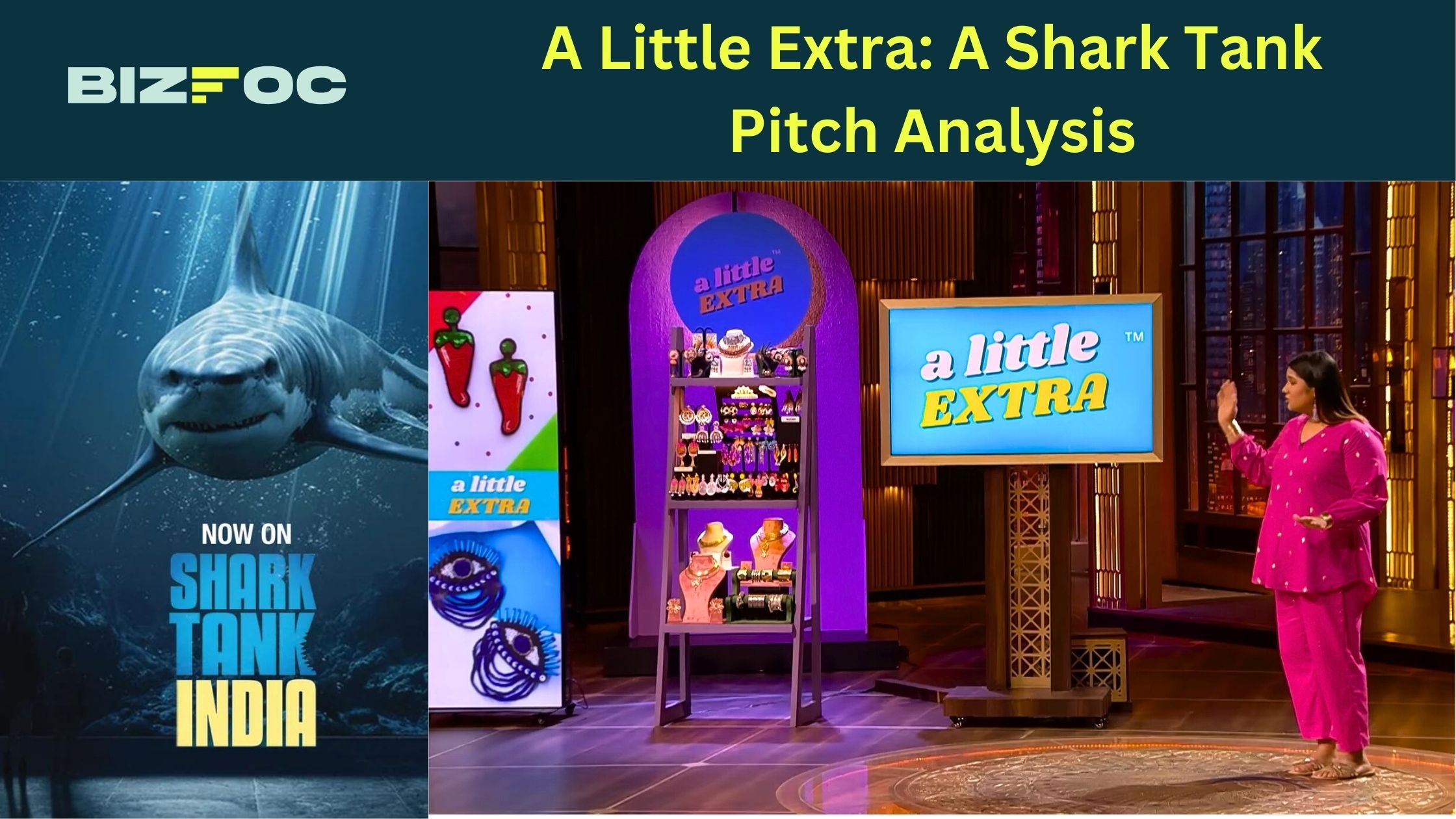
A Little Extra, a brand founded by Diksha Singhi, was recently featured on Shark Tank India Season 3, aiming to secure investment for their business of manufacturing funny and quirky jewellery. This analysis delves into the details of A Little Extra, encompassing its establishment, ownership structure, business model, products, and the Sharks' decisions regarding their pitch.
| Airing time | February 9, 2024, Episode 15 (Season 3) |
| Brand | A Little Extra |
| Company Name | NA |
| Company Registration | Delhi, India |
| Company Incorporation Date | 2020 |
| Business Category | Fashion Accessories Manufacturing |
| USP | Fun and quirky jewellery inspired by people’s emotions, occasions, moods and festivities |
| Co-founders/Directors | Founder - Diksha Singhi |
| Company Authorized Capital | NA |
| Company Paid-up Capital | NA |
| Website | https://alittleextra.co.in/ |
| Sales/EBITDA/Profits |
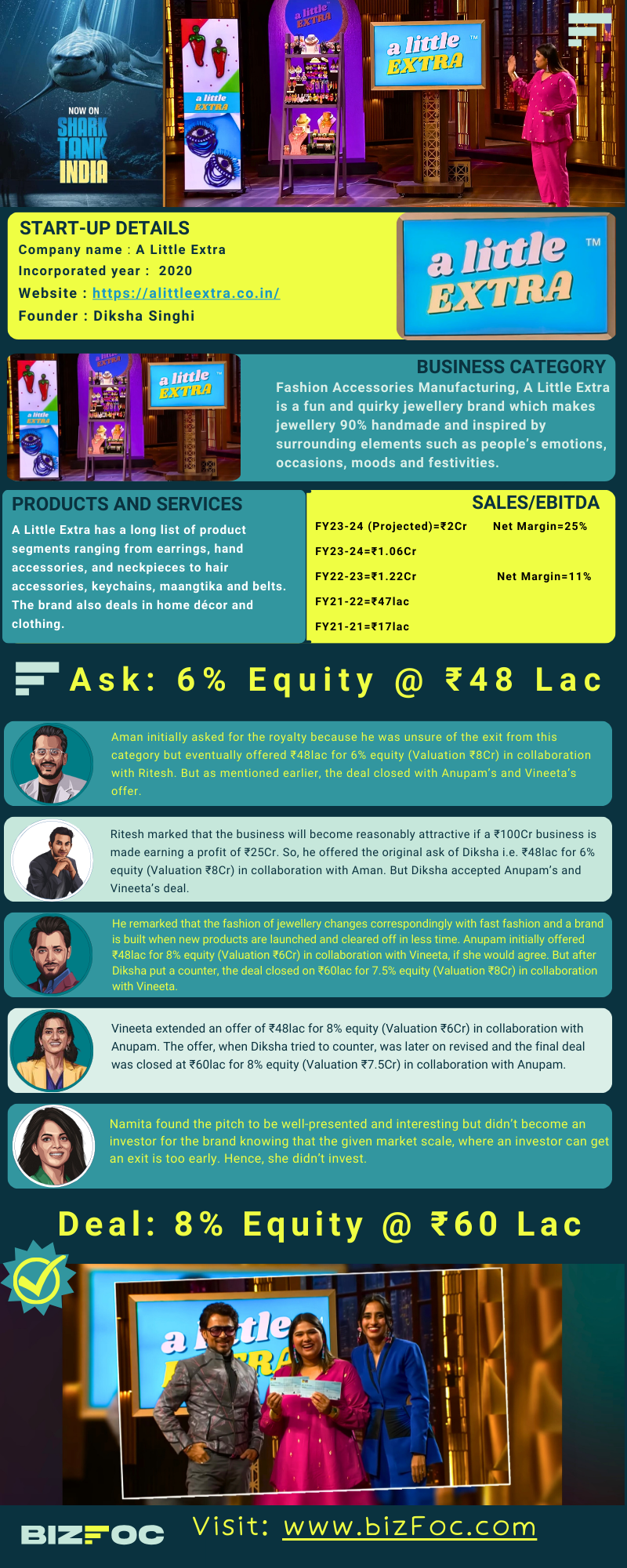
Annual Sales: FY23-24 (Projected) = ₹2 Cr, Net Margin = 25% FY23-24 (Till November) = ₹1.06 Cr FY22-23 = ₹1.22 Cr, Net Margin = 11% FY21-22 = ₹47 lac FY21-21 = ₹17 lac Unit Economic Cost of goods sold: 25% Gross Margin: 75% Packaging: 4.5% Maintenance, rent & overhead costs: 14% Projected Ad spend: 6% Salaries: 3% Shopify & Razorpay commission: 3.5% Shipping cost: 7% Profit before tax: 25% Prices are set at 4X-%X of making cost (at least 75% of gross margin) Initial investment = ₹5,000 Products sold = 80,000+ Own designs = 75% Curated designs = 25% Handmade = 90% Sales through online website = 100% Average Selling Price = ₹450 Customer repeat rate = 17-18% 60% of sales from fabric jewellery |
| Ask | ₹48 lac for 6% equity (Valuation ₹8 Cr) |
| Pre-round | NA |
| Deal pakki? | The deal got closed with Anupam’s and Vineeta’s offer of ₹60 lac for 8% equity (Valuation ₹7.5 Cr) |
A Little Extra incorporated its business in 2020. This company is headquartered in Delhi, India. With over 80,000 products sold till date, the brand has launched over 500 products. The company was started by Diksha Singhi in 2020. The brand makes products which are 90% handmade with manufacturers situated in Delhi, West Bengal, Assam and Uttar Pradesh
Diksha Singhi is the owner of A Little Extra. She owns 100% equity of the company. She hails from a Marwari family of Guwahati, Assam but shifted to Delhi about ten years ago. She started her business with an investment of just ₹5,000. Her father wanted her to be a CA but she hated numbers. She did her studies from Indraprastha College for Women, University of Delhi in mass communication and journalism. Fond of social media marketing and storytelling, she started an agency of her own but closed it in 3-4 years because she was not enjoying the work much. Having a deep fascination with jewellery, she started her company in 2020 and now she has sold more than 80,000 products to date.
A Little Extra is a fun and quirky jewellery brand, with products 90% handmade and inspired by people’s emotions, occasions, moods and festivities. The brand has launched more than 500 designs to date, priced at an affordable range, and aims to make jewellery a tool of emotional expression.
A Little Extra offers a wide range of products including earrings, hand accessories, neckpieces, hair accessories, keychains, maangtika, belts, home décor, and clothing. The brand focuses on bringing a modern touch to ancient art forms, with detailed information about products available at: https://alittleextra.co.in/collections/all
A Little Extra presented their pitch in Shark Tank India seeking an investment of ₹48 lac for 6% equity (Valuation ₹8 Cr).
The Sharks' decisions reflect several key considerations for A Little Extra:
Strengths:
Weaknesses:
A Little Extra shows growth potential. It is a new entry with new and quirky jewellery which are 90% handmade. The brand has growth prospects in fast fashion chains. The brand reflects considerable growth once it expands its distribution channels through e-commerce platforms. The founder wants to increase exports from current 10% to 30-35%.
A Little Extra’s appearance in Shark Tank India Season 3 highlighted the prospective growth prospects of the business. The brand’s new and unique jewellery which is inspired by people’s emotions, occasions, festivities and moods, along with an affordable price showcases the growth prospects. Its presence in the fast-moving jewellery fashion can be surely marked once the production cycle time is reduced to 7-8 days. The remarkable social media hold and future entry on e-commerce platforms demonstrates the chances of becoming a business of ₹100 Cr. The brand has a promising future.

More trusted, Verified reviews
 180+ Reviews
Bizfoc is an accounting firm offering solutions related to company registration in India, accounting services, stock audit, GST, TDS & income tax. Our team exemplifies brilliance in distinct industries using flexible and customized solutions.


Unit No. 235, II Floor, JMD Megapolis Sohna Rd,Sector 48 Gurugram, Haryana, 122018
Unit No. 2303A, 23rd Floor, The Iconic Corenthum, Sector 62, Noida, Uttar Pradesh, 201309 (Next to Noida Electronic City Metro Station)
© 2024 Bizfoc. All Rights Reserved. Made with