
The Cinnamon Kitchen, a brand founded by Yash Sakhlecha, Rij Eappen, and Dishant Sanghvi, recently featured on Shark Tank India Season 3, aiming to secure investment for their world's first social currency powered payments card VISA payments bank. This analysis delves into the details of The Cinnamon Kitchen, encompassing its establishment, ownership structure, business model, products, and the Sharks' decisions regarding their pitch.
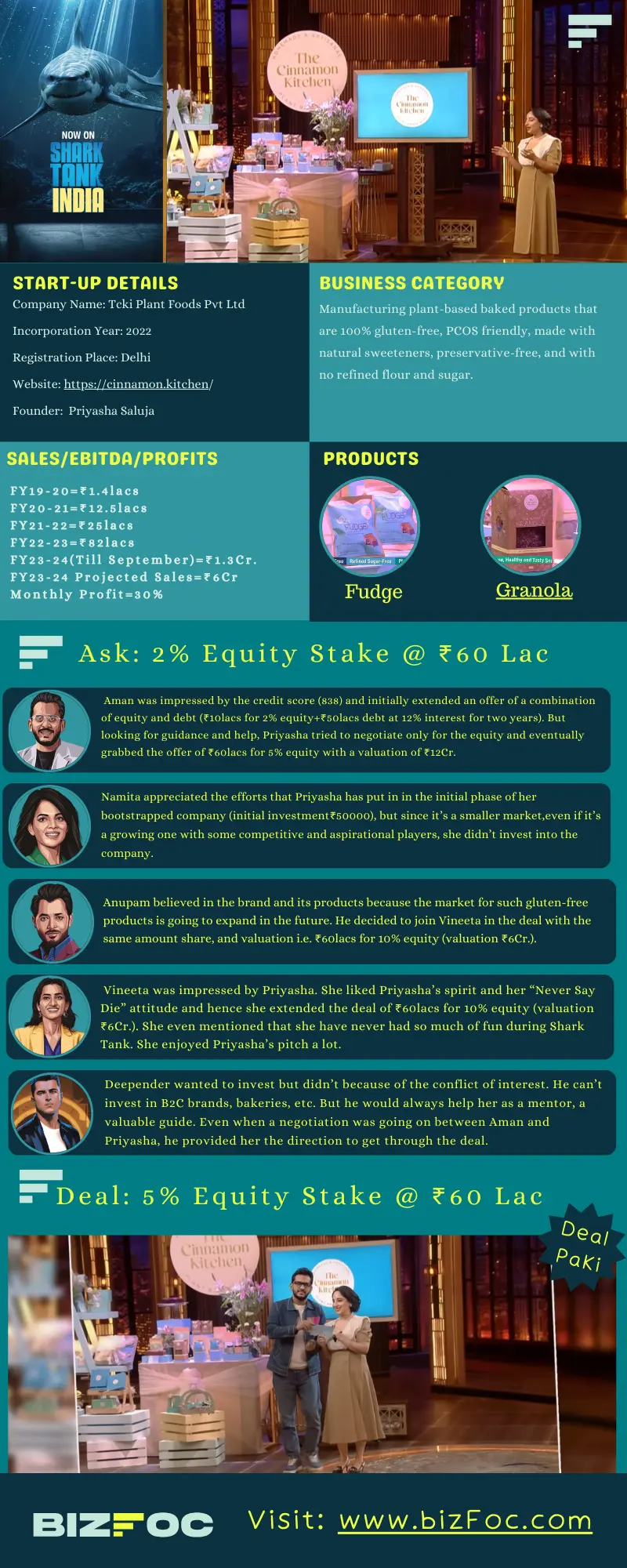
| Airing time | January 23, 2024, Episode 2 (Season 3) |
| Brand | The Cinnamon Kitchen |
| Company Name | TCKI PLANT FOODS PVT. LTD. |
| Company Registration | East Delhi, Delhi, India |
| Company Incorporation Date | June 14, 2022 |
| Business Category | Food Products & Beverages (Manufacturing) |
| USP | Unique recipes (100% gluten-free, plant-based, PCOS friendly, preservative-free, no refined flour or sugar) |
| Co-founders/ Directors | Directors- Alka Saluja (1% share), Priyasha Saluja (99% share) |
| Company Authorized capital | ₹10,00,000 |
| Company Paid-up capital | ₹1,00,000 |
| Website | https://cinnamon.kitchen/ |
| Sales/EBITDA/Profits |
Sales:
Unit Economic:
|
| Ask | ₹60lacs for 2% equity, Valuation=₹30Cr. |
| Pre-round | NA |
| Deal pakki? | Aman Gupta offered ₹60lacs for 5% equity and ₹20Cr. Valuation. Priyasha Saluja accepted the offer and the deal was finalized. |
The Cinnamon Kitchen is part of a bootstrapped company, namely TCKI Plant Foods Private Limited with a company incorporation date on June 14, 2022. This company is registered in East Delhi, Delhi, India. Their 2500 square feet manufacturing unit is in Noida Sector 63 with around 45 SKUs (Stock Keeping Units). Their distribution channels include some retail stores, Amazon, Blinkit, and their website.
The Cinnamon Kitchen is owned by Priyasha Saluja & Alka Saluja, with 99% and 1% share respectively. The journey started when Priyasha was diagnosed with PCOS as a young teenager. Later on, when she moved from Delhi to Bombay, she had access to kitchen space and ended up doing countless trials for healthy snacks. Before starting with The Cinnamon Kitchen, she was working in Dentsu Aegis in the Advertising sector where she worked with brands such as Parle, Switzerland Tourism, Wildcraft, etc.
The Cinnamon Kitchen operates with a B2C business model, manufacturing plant-based baked products that are 100% gluten-free, PCOS friendly, made with natural sweeteners, preservative-free, and with no refined flour and sugar. Their distribution channel includes some retail stores, Amazon, Blinkit, and their very own website. They operate in two segments: Fresh Cakes & Bakery and Packaged Items.
The Cinnamon Kitchen offers a variety of products including Chocolate Fudge, Methi Millet Crackers, Flourless Almond Butter Cookies, Spicy Vegan Cheese Chips, and many more. In total, they have 45 SKUs (Stock Keeping Units). A detailed list along with the prices of their products can be found at: https://cinnamon.kitchen/collections/all.
The Cinnamon Kitchen presented their pitch in Shark Tank India seeking an investment of ₹60lacs for 2% equity & valuation of ₹30Cr.
The Sharks' decisions reflect several key considerations for The Cinnamon Kitchen:
Strengths:
Weaknesses:
The future of The Cinnamon Kitchen can be projected in terms of growth in sales and production capacity. The projected sales for the years 2023-2024 were ₹6Cr. and the market for Healthy Indian Snacking has a 20% year-on-year growth. Hence, the future of the brand looks vibrant and successful.
The Cinnamon Kitchen's appearance in Shark Tank Season 3 highlighted how countless efforts and dedication can result in unique recipes and ultimately make a business opportunity from those recipes. The founder's insights on her story and her hard work paid off when she got a deal from 3 sharks and ultimately converted it into Aman's deal. Her efforts are evident from her unique and tasty recipes complemented with a justified price. Their business has growth potential in the future.

More trusted, Verified reviews
 180+ Reviews
Bizfoc is an accounting firm offering solutions related to company registration in India, accounting services, stock audit, GST, TDS & income tax. Our team exemplifies brilliance in distinct industries using flexible and customized solutions.


Unit No. 235, II Floor, JMD Megapolis Sohna Rd,Sector 48 Gurugram, Haryana, 122018
Unit No. 2303A, 23rd Floor, The Iconic Corenthum, Sector 62, Noida, Uttar Pradesh, 201309 (Next to Noida Electronic City Metro Station)
© 2024 Bizfoc. All Rights Reserved. Made with