
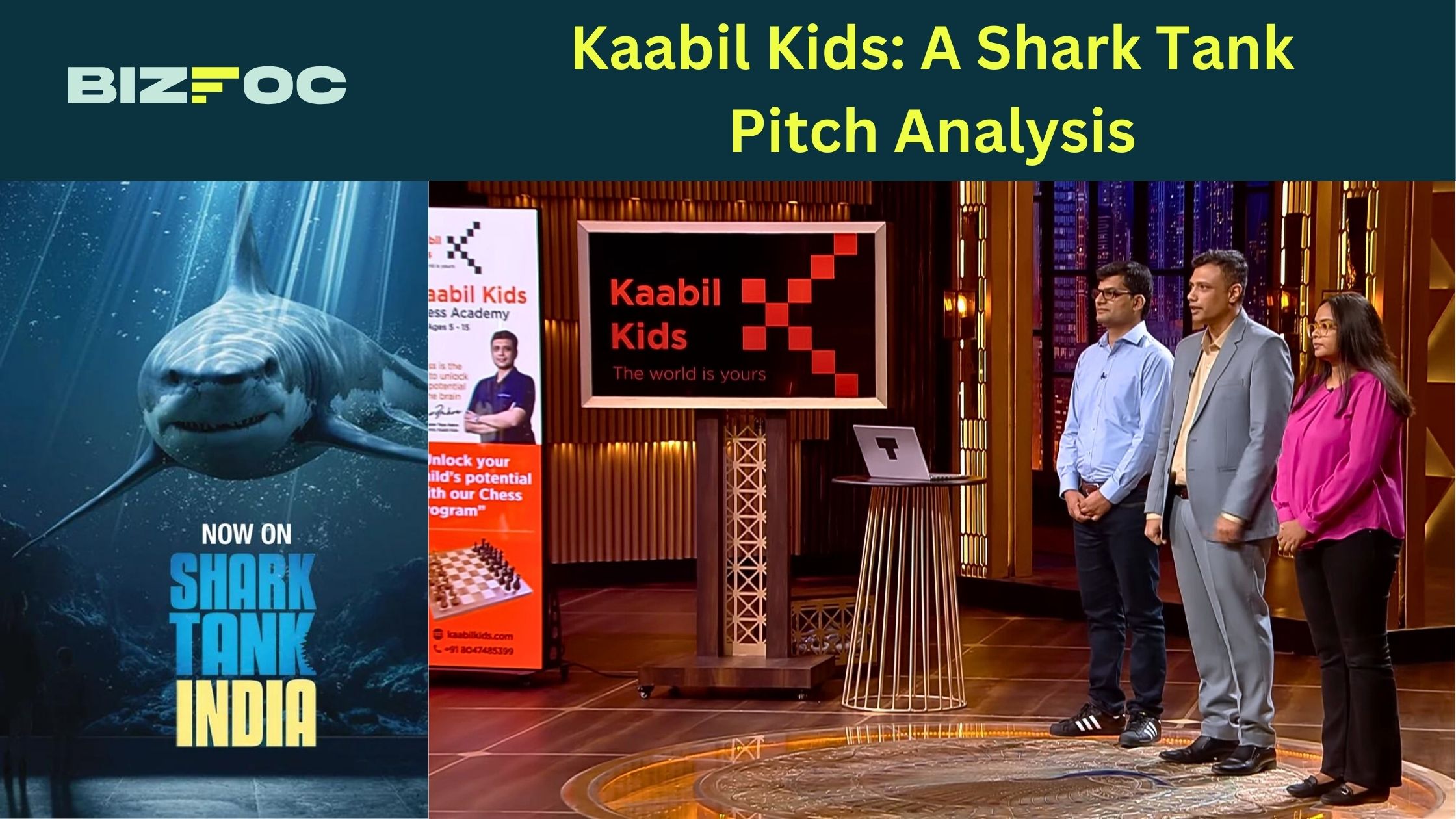
Kaabil Kids is a global online chess training academy catering to children aged 5-15 years. Established in 2019, Kaabil Kids is a cutting-edge virtual chess teaching program designed to provide kids access to expert chess instruction. The organization provides a thorough curriculum created by grandmasters and taught by qualified trainers with a FIDE rating. The program is designed to improve young learners' critical thinking, problem-solving, and decision-making abilities. With an emphasis on providing a secure, enjoyable, and stimulating learning environment, Kaabil Kids aims to make chess instruction accessible and inexpensive. The platform features cutting-edge education that has a thorough understanding of child psychology, as well as strong performance evaluation capabilities. Kaabil Kids, which employs over 32 people and has received substantial venture capital support, has successfully registered thousands of kids and taught many lessons. Additionally, the business was highlighted on Shark Tank India, demonstrating its legitimacy and promise in the educational field. This Startup made the pitch in Shark Tank Season 3 which was covered in the 42nd episode.
| Airing Time | Shark Tank Season 3: Episode 42 |
| Brand | Kaabil Kids |
| Company Name | SHINEMIND LEARNING PRIVATE LIMITED |
| Company Registration | Kanpur, India |
| Company Incorporation Date | 8th November 2019 |
| Business Category | Online Chess Training Academy |
| USP | Grand Master Designed Curriculum |
| Co-founders/Directors | Sunil Raina, Nisha Raina, and Kitty Mahapatra |
| Company Authorized Capital | ₹50 Lakhs |
| Company Paid-up Capital | ₹6.78 Lakhs |
| Website | https://www.kaabilkids.com/ |
| Sales/EBITDA/Profits |
Monthly Sales: ₹29 Lakhs FY23-24: ₹1.45 Cr (till September) Burn: ₹3-₹4 Lakhs |
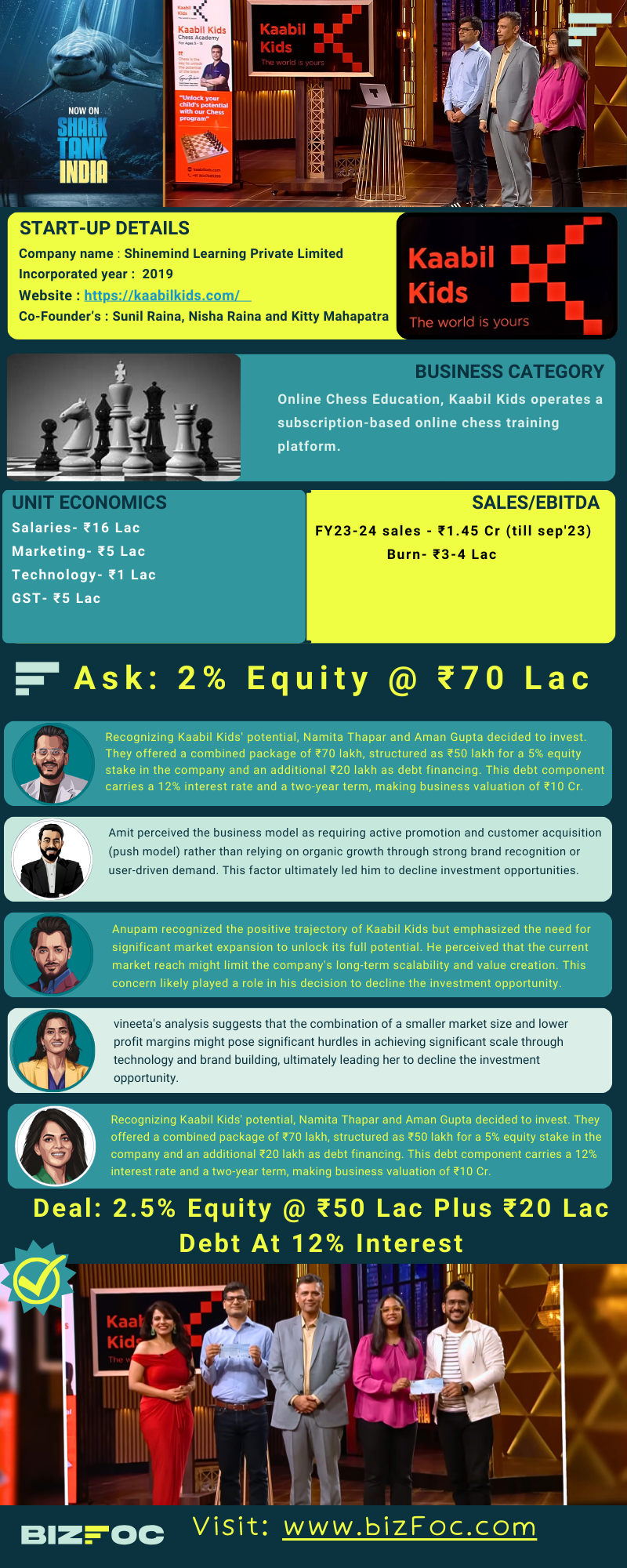
| Unit Economics | August’ 23 Sales: ₹29 Lakhs Salaries: ₹16 Lakhs Marketing: ₹5 Lakhs Technology: ₹1 Lakhs GST: ₹5 Lakhs EBITDA: ₹2 Lakhs |
| Business Valuation Ask | ₹70 Lakhs for 2% equity at a business valuation of ₹35 Cr |
| Pre-round | September 2022: Raised ₹1.7 Cr at a post-money valuation of ₹20 Cr |
| Deal Pakki? | ₹50 Lakhs for 2.5% equity with ₹20 Lakhs debt at 12% for 2-year tenure with Shark Namita and Aman |
Kaabil Kids has the Company name SHINEMIND LEARNING PRIVATE LIMITED, with the registration in Kanpur, India, on 8th November 2019. The company is operating with the authorized and paid-up capital of ₹50 lakhs and ₹6.78 lakhs respectively.
Sunil Raina, Nisha Raina, and Kitty Mahapatra are the co-founders of Kaabil Kids. The founders of Kaabil Kids are the main owners of this privately held business. Together, the founders own a sizeable majority investment of 63.09%, demonstrating their great influence over and stake in the expansion and future of the business, where Sunil holds 57% of the company and Kitty has 11% possession of the company. GM Tejas receives ₹6 Lakhs annually in Cash and equity of 0.15% from Kaabil Kids. The remaining is a split between other investors having 25%, ESOPs having 5%, and others comprising 1.05%. The business has raised money through several fundraising rounds, including angel and early-stage venture capital. In addition to offering financial stability, this diverse ownership structure also attracts experienced investors and strategic ideas, supporting Kaabil Kids in its endeavor to transform children's online chess education.
Kaabil Kids is a subscription-based company that provides kids with a range of online chess instruction courses. Grandmasters have created a variety of courses on the site, ranging from beginning to advanced levels, and FIDE-rated coaches with expertise teach them. The design of these courses is to improve students' ability to think critically, solve problems, and make decisions. Monthly and yearly membership fees that provide access to live lessons, recorded sessions, and individualized coaching are how Kaabil Kids makes money. To further broaden its reach, the organization also provides unique packages for educational institutions and schools. To help parents watch their child's growth, the business model also incorporates progress monitoring and performance measuring tools. Kaabil Kids wants to democratize chess instruction by emphasizing accessibility and cost so that it is available to a wider range of people.
Kaabil Kids provides a selection of goods and services with an emphasis on teaching kids chess online. The website offers a grandmaster-designed, organized curriculum that is taught by FIDE-rated, seasoned coaches. This curriculum is designed to accommodate players of all skill levels, from novices to experts, guaranteeing a thorough educational experience. Personalized coaching to meet individual needs, recorded sessions for flexible learning, and live, interactive workshops are all included in the offerings. Furthermore, Kaabil Kids often hosts online events and tournaments to encourage a spirit of competitiveness and offer real-world experience. Strong performance assessment tools on the site also assist in monitoring students' advancement and pinpointing areas in need of development. Kaabil Kids wants to democratize chess teaching by emphasizing accessibility and cost, making it available to a wider audience. The company also offers special packages for schools and educational institutions, further expanding its reach and impact. Detailed information about their services can be found at: www.kaabilkids.com
Kaabil Kids presented their pitch in Shark Tank India seeking an investment of ₹70 Lakhs for 2% equity at the business valuation of ₹35 Cr.
a) Aman: He was impressed by the prospects and planning of the founders to achieve their goal and hence gave a collective offer with Shark Namita of ₹50 Lakhs for 5% equity with ₹20 Lakhs debt at 12% interest for 2-year tenure initially.
b) Amit: He didn’t invest because he believed a completely tech-based platform without much human intervention would be more interesting for him, as tech products enable faster scalability, and currently, the product does not require much organic demand. Hence, he didn’t invest.
c) Vineeta: She believed that the target market size of the business model is very small to achieve scalability. Another reason for her disinterest is the high consumer acquisition cost and low gross margin, which does not make this business investable for her. Hence, she didn’t invest.
d) Namita: She agreed to Aman’s point of view and gave a collaborative offer of ₹50 Lakhs for 5% equity with ₹20 Lakhs debt at 12% interest for a 2-year tenure initially, but both Sharks agreed to match the same valuation as the previous investment round.
e) Anupam: He believes that besides the small market size, the threat from AI is very big for the business model. To increase the value, founders need to capture the entire market for which they lack the required capex. Hence, he didn’t invest.
After certain negotiations, the founders got a deal of ₹50 Lakhs for 2.5% equity with ₹20 Lakhs debt at 12% for a 2-year tenure with Shark Namita and Aman.
Grandmaster Tejas Bakre and his group introduced Kaabil Kids, an online chess teaching program, on Shark Tank India. The program is intended for kids ages 5 to 15. Sharks Aman Gupta and Namita Thapar inquired about the company plan, prospective market, and histories of the founders as they offered ₹70 lakh for a 2% stake. Aman Gupta wanted to know how Kaabil Kids intended to close the chess education gap in the market. Namita Thapar emphasized the significance of utilizing technology to improve the educational experience and reach a wider audience while focusing on the founders' goals for the business and their journey. The sharks outlined Kaabil Kids' advantages, such as its cutting-edge curriculum and skilled instructors, but they also brought up some possible drawbacks, like difficulties with scaling and the tough scenery. Another issue was the expense of acquiring new customers, which highlighted the necessity of efficient marketing techniques. Following a thorough conversation, the founders made an offer of ₹50 lakh for 5% ownership and ₹20 lakh for a loan with a two-year interest rate of 12%. In the end, ₹50 lakh was exchanged for 2.5% equity and ₹20 lakh in debt with a two-year interest rate of 12%. According to the sharks' research, Kaabil Kids has the potential to lead the online chess teaching market if they successfully manage the issues raised and make the most of their investment.
An online chess instruction startup called Kaabil Kids received a favorable reaction from investors Aman Gupta and Namita Thapar in India. The founders' smart approach and clear goal intrigued the sharks, who noted the rising interest in chess among young students and its potential to foster strategic thinking. Their goal was to improve technical infrastructure and expand operations by offering a ₹20 lakh debt at 12% interest for two years and ₹50 lakh in exchange for 2.5% equity. The sharks stressed the value of technology in giving kids a smooth educational experience and the possibility of Kaabil Kids' international growth as a result of chess's widespread popularity and the rising need for high-quality online education. They believed that with the right guidance and financial support, Kaabil Kids could become a leader in the online chess education space, both in India and internationally.
Kaabil Kids' pitch highlighted key strengths in their business model and product. They were initially concerned about the business’s small market size and high customer acquisition cost. Further, the Sharks felt that investing in this would be pretty profitable and hence, founders got a great deal.

More trusted, Verified reviews
 180+ Reviews
Bizfoc is an accounting firm offering solutions related to company registration in India, accounting services, stock audit, GST, TDS & income tax. Our team exemplifies brilliance in distinct industries using flexible and customized solutions.


Unit No. 235, II Floor, JMD Megapolis Sohna Rd,Sector 48 Gurugram, Haryana, 122018
Unit No. 2303A, 23rd Floor, The Iconic Corenthum, Sector 62, Noida, Uttar Pradesh, 201309 (Next to Noida Electronic City Metro Station)
© 2024 Bizfoc. All Rights Reserved. Made with