
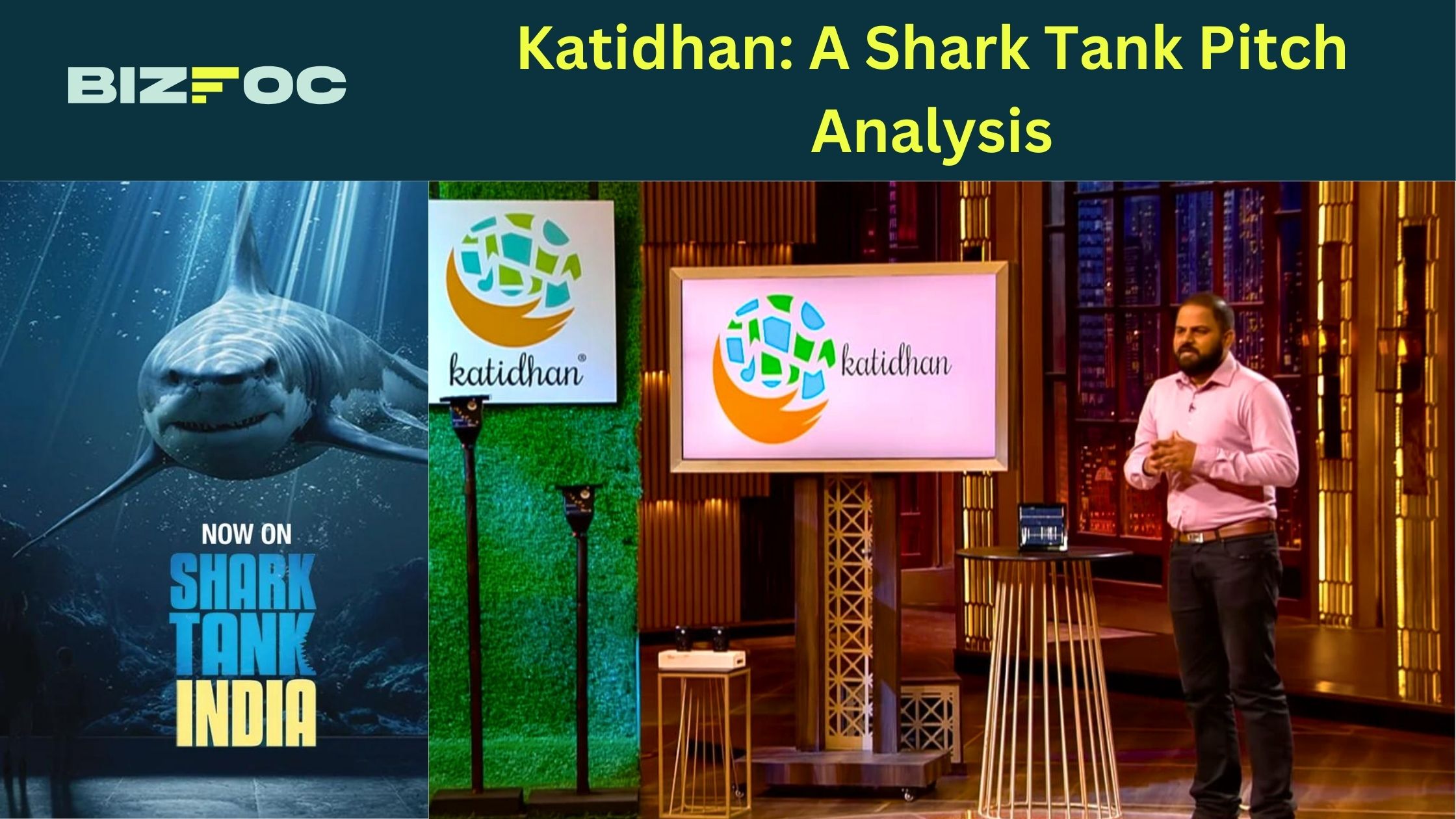
Katidhan, a brand founded by Ayan Syed Rehmatul, recently featured on Shark Tank India Season 3, aiming to secure investment for their Agritech business-to-government (B2G) and business-to-business (B2B) brand. This analysis delves into the details of Katidhan, encompassing its establishment, ownership structure, business model, products, and the Sharks' decisions regarding their pitch.
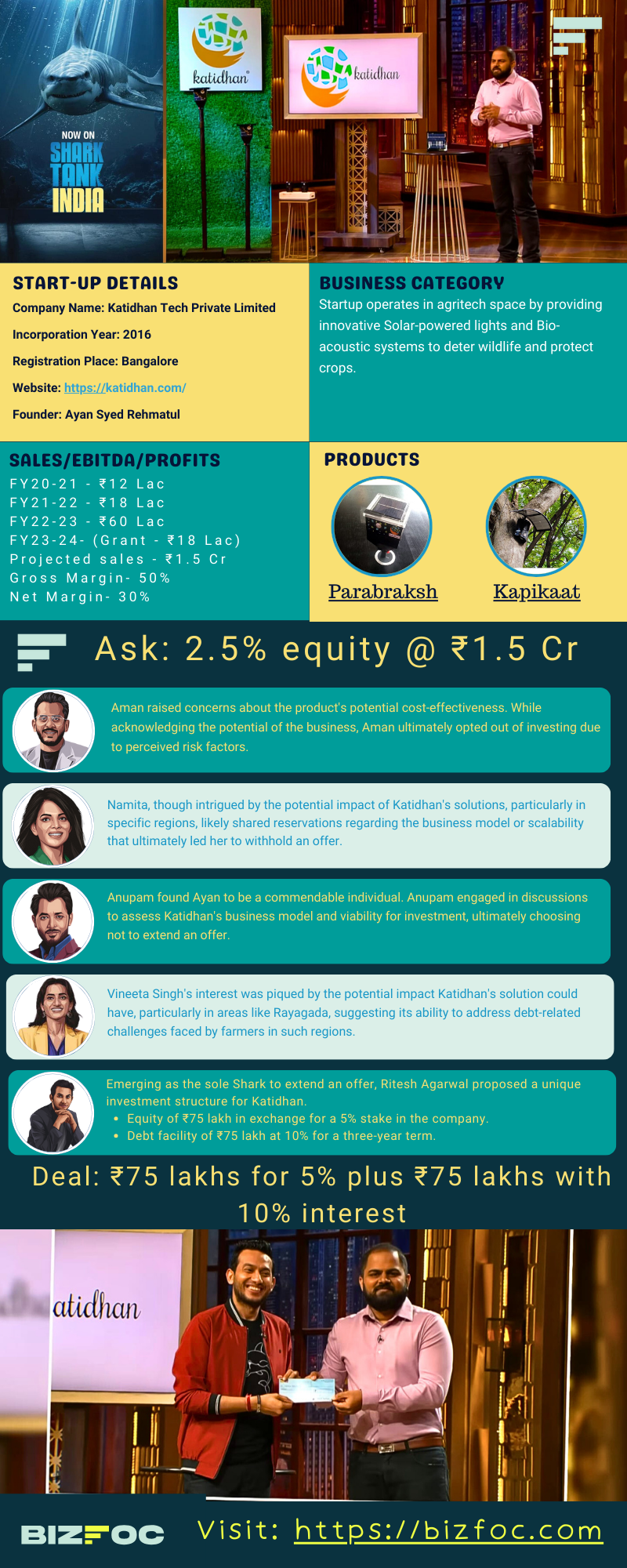
| Airing time | March 2024 Episode 41 (Season 3) |
| Brand | Katidhan |
| Company Name | Katidhan Tech Private Limited |
| Company Registration | Bangalore, India |
| Company Incorporation Date | 01 December 2016 |
| Business Category | Innovative Solar-powered lights and Bio-acoustic systems to deter wildlife and protect crops |
| USP | Innovative Solar-powered lights and Bio-acoustic systems to deter wildlife and protect crops |
| Founder/Directors | Ayan Syed Rehmatul (Founder) & Subham Banerjee (Director) |
| Company Authorized Capital | ₹ 1 Lac |
| Company Paid-up Capital | ₹ 1 Lac |
| Website | https://katidhan.com/ |
| Ask | ₹1.5 Cr for 2.5% Equity with business valuation of ₹60 Cr |
| Pre-round | NA |
| Sales | FY20-21: ₹12 Lac, FY21-22: ₹18 Lac, FY22-23: ₹60 Lac, FY23-24 (Grant): ₹18 Lac. Projected sales: ₹1.5 Cr. Gross Margin: 50%, Net Margin: 30% |
| Deal pakki? | ₹75 Lac for a 5% equity stake plus ₹75 Lac debt at 10% interest rate for 3 years with a business valuation of ₹15 Cr from Shark Ritesh |
Katidhan has the company name Katidhan Tech Private Limited with company incorporation date on 01 December, 2016. This company is registered in Bangalore, India. Katidhan has achieved significant market traction, with installations of their products across 1,300 farms and agricultural lands.
Ayan Syed Rehmatul founded Katidhan. S.R. Ayan serves & Subham Banerjee are the Directors of the company. The company has authorised capital amounts to ₹1 Lac, with a paid-up capital of ₹1 Lac.
Katidhan employs a direct sales model within the agritech sector. They focus on research, development, and manufacturing of innovative wildlife deterrent solutions. Their product portfolio includes Parav, a solar-powered animal deterrence system, and KopiKant, a bio-acoustic deterrent system. Revenue generation likely occurs through direct sales to farmers or via established agricultural supply store channels.
Katidhan, a company specialising in agricultural technology, addresses the challenge of human-wildlife conflict. Their innovative Parav lights utilise strategic solar-powered patterns to deter nocturnal animals. Additionally, KopiKant, their bio-acoustic system, emits species-specific sounds to keep wildlife away from crops. These technological solutions empower farmers to protect their fields.
Ayan, representing Katidhan, presented his company on Shark Tank India seeking an investment of ₹1.5 Cr in exchange for a 2.5% equity stake, valuing the company at ₹60 Cr.
The Sharks' decisions reflect several key considerations for Katidhan:
Strengths:
Weaknesses:
Securing a deal with Ritesh presents a significant growth opportunity for Katidhan. The influx of capital will likely fuel the mass production of their Parav lights and KopiKant sound systems. Additionally, Ritesh's extensive network provides Katidhan with potential access to valuable marketing resources. This strategic partnership could propel Katidhan's market reach, empowering a wider range of farmers with their innovative wildlife deterrent solutions.
Katidhan's Shark Tank India appearance yielded a partial win. Ritesh Agarwal's investment offers a financial boost. While other Sharks expressed interest, concerns about scalability and cost might have hampered their offers. This investment presents an opportunity for Katidhan to strengthen its position in the agritech sector and drive further innovation.

More trusted, Verified reviews
 180+ Reviews
Bizfoc is an accounting firm offering solutions related to company registration in India, accounting services, stock audit, GST, TDS & income tax. Our team exemplifies brilliance in distinct industries using flexible and customized solutions.


Unit No. 235, II Floor, JMD Megapolis Sohna Rd,Sector 48 Gurugram, Haryana, 122018
Unit No. 2303A, 23rd Floor, The Iconic Corenthum, Sector 62, Noida, Uttar Pradesh, 201309 (Next to Noida Electronic City Metro Station)
© 2024 Bizfoc. All Rights Reserved. Made with