
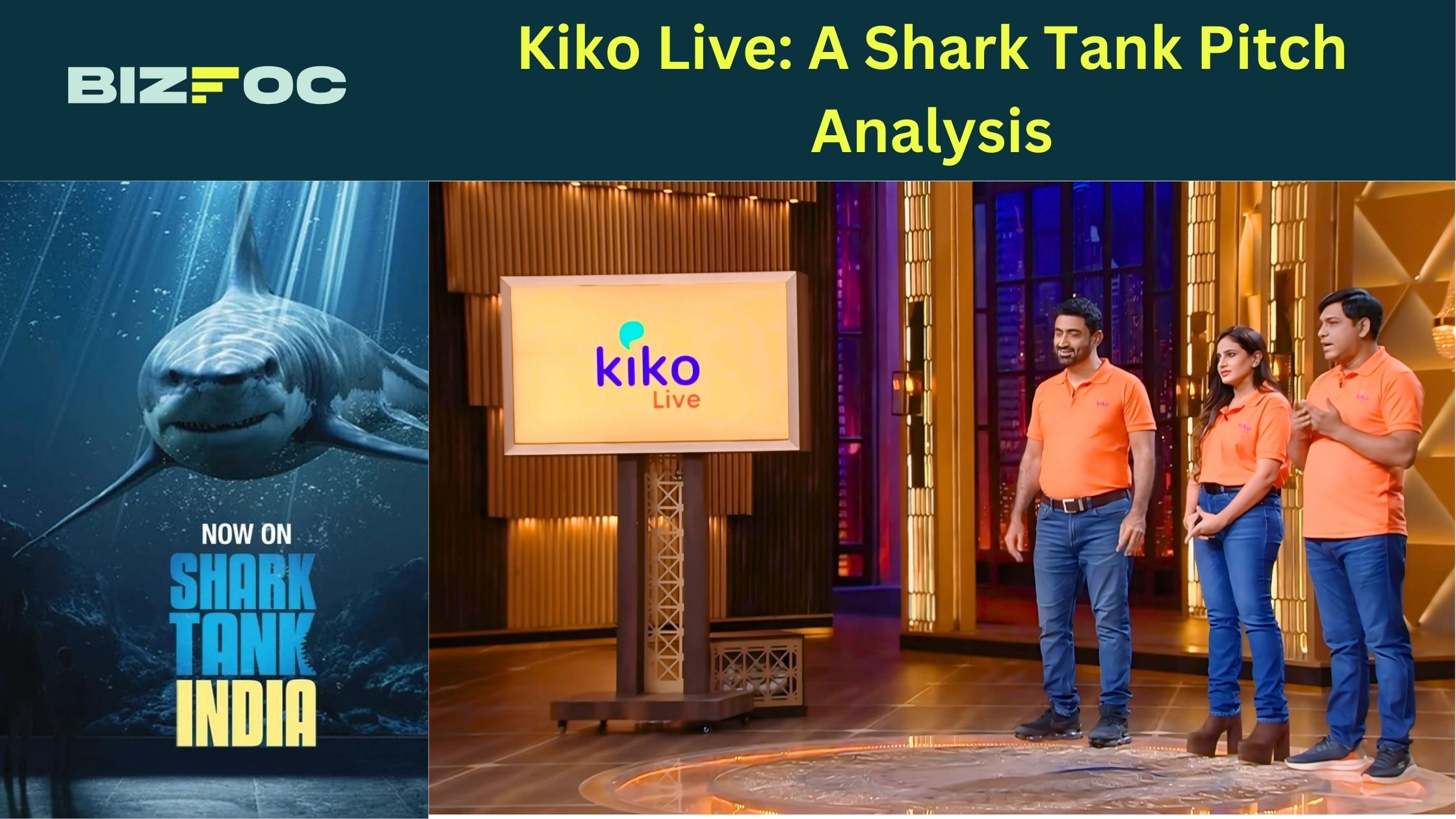
Kiko Live, a brand co-founded by Virendra Kumar Chouhan, Neeta Alok Chawla, and Alok Satyadev Chawla, recently featured on Shark Tank India Season 3, aiming to secure investment for their E-commerce enabler business-to-business (B2B) brand. This analysis delves into the details of Kiko Live, encompassing its establishment, ownership structure, business model, products, and the Sharks' decisions regarding their pitch.
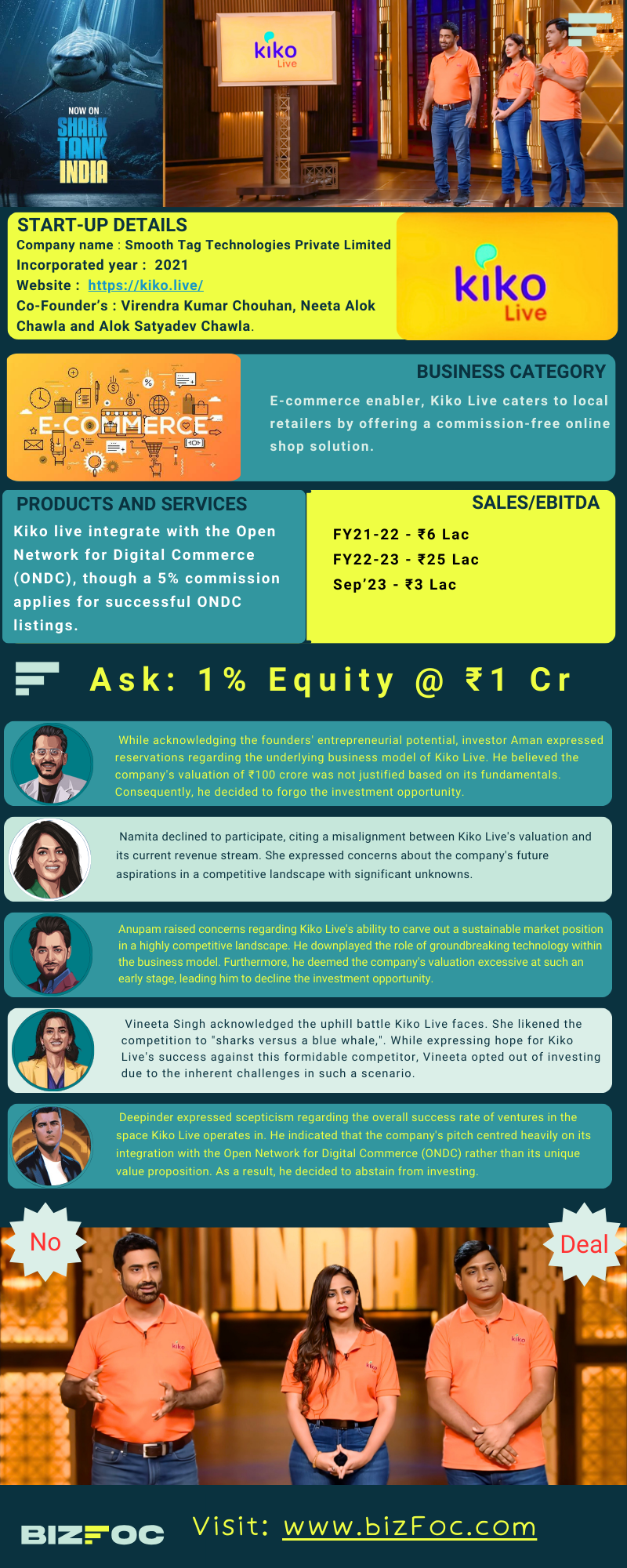
| Airing time | March 2024 Episode 47 (Season 3) |
| Brand | Kiko Live |
| Company Name | Smooth Tag Technologies Private Limited |
| Company Registration | Gwalior, Madhya Pradesh |
| Company Incorporation date | 17 August 2020 |
| Business Category | E-commerce enabler |
| USP | Empowers local retailers by digitizing their business and integrating them with the Open Network for Digital Commerce (ONDC) |
| Co-founders/Directors | Virendra Kumar Chouhan, Neeta Alok Chawla, and Alok Satyadev Chawla |
| Company Authorized capital | ₹10 Lac |
| Company Paid-up capital | ₹1.5 Lac |
| Website | https://kiko.live/ |
| Sales/EBITDA/Profits | FY21-22 - ₹6 Lac FY22-23 - ₹25 Lac Sep’23 - ₹3 Lac |
| Ask | ₹1 Cr for 1% Equity with business valuation of ₹100 Cr |
| Pre-round | In 2021- ₹90 Lac - ₹9 Cr Valuation ₹7 Cr - ₹28 Cr Valuation In 2023- ₹5.5 Cr - ₹80 Cr Valuation |
| Deal pakki? | No Deal |
Kiko Live has the company name Smooth Tag Technologies Private Limited with company incorporation date on 17 August 2020. This company is registered in Gwalior, Madhya Pradesh, India. Kiko Live boasts a network of over 1,000 partnered sellers, having established a dedicated seller portal in August 2023 to facilitate their online presence.
Virendra Kumar Chouhan, Neeta Alok Chawla, and Alok Satyadev Chawla co-founded Kiko Live. The company has authorised capital amounts to ₹10 Lac, with a paid-up capital of ₹1.5 Lac. Alok Chawla brings a strong academic foundation to Kiko Live, having earned his MBA from the prestigious Narsee Monjee Institute of Management Studies in Mumbai. Prior to his entrepreneurial endeavours, he gained valuable experience through a one-year stint at Asian Paints. His track record in the industry is further evidenced by his involvement in ZipCash, a previous venture. Additionally, Alok Chawla co-founded Gizmobaba alongside his wife, Neeta Chawla, demonstrating a collaborative approach to business leadership.
Kiko Live employs a two-pronged revenue model designed to empower local retailers. Firstly, they offer a commission-free online shop solution, allowing sellers to retain full profits from orders and deliveries fulfilled through their Kiko Live platform. This fosters a cost-effective entry point for businesses venturing into e-commerce. Secondly, Kiko Live integrates with the Open Network for Digital Commerce (ONDC), significantly expanding seller reach. However, for successful product listings on ONDC, a 5% commission fee is implemented. This tiered approach caters to both cost-conscious businesses and those seeking a wider customer base.
Kiko Live caters to local retailers by offering a commission-free online shop solution. This empowers businesses to establish their own branded website, manage product listings, and receive support with local deliveries. Additionally, Kiko Live boasts a patented system for interactive online shopping experiences. For broader reach, they integrate with the Open Network for Digital Commerce (ONDC), though a 5% commission applies for successful ONDC listings. This dual approach empowers local retailers with a cost-effective e-commerce solution and the potential to tap into a national marketplace.
In a bid to secure funding, Kiko Live's founders reportedly sought an investment of ₹1 Cr for a 1% stake in the company. This proposition implies a pre-money valuation of ₹100 Cr for Kiko Live.
Here's a breakdown of shark's decisions about Kiko Live:
Despite a valiant effort by the founders, none of the investors on Shark Tank chose to invest in Kiko Live.
The Sharks' decisions reflect several key considerations for Kiko Live:
Strengths:
Weaknesses:
The future trajectory of Kiko Live hinges on its ability to navigate a competitive e-commerce landscape for local retailers. While the commission-free online shop solution and ONDC integration offer compelling advantages, Kiko Live must establish a clear path to differentiation. The success of their patented live shopping technology in driving customer engagement will also be crucial. Furthermore, securing sufficient funding to compete effectively against well-established players is paramount. Kiko Live's prospects will depend on their ability to overcome these challenges and effectively leverage their strengths to carve out a sustainable market position.
Despite a well-presented pitch highlighting a commission-free online shop solution and integration with the Open Network for Digital Commerce (ONDC), Kiko Live failed to secure investment on Shark Tank. The Sharks, while impressed with the founders' potential, expressed concerns regarding the company's high valuation, intense competition in the e-commerce space, and dependence on the nascent ONDC platform. Additionally, the limitations of the investment offered on Shark Tank compared to the vast resources of potential competitors like Jio were a factor. Overall, the Sharks believed Kiko Live needed to refine its differentiation strategy, secure more substantial funding, and navigate the competitive landscape to achieve long-term success.

More trusted, Verified reviews
 180+ Reviews
Bizfoc is an accounting firm offering solutions related to company registration in India, accounting services, stock audit, GST, TDS & income tax. Our team exemplifies brilliance in distinct industries using flexible and customized solutions.


Unit No. 235, II Floor, JMD Megapolis Sohna Rd,Sector 48 Gurugram, Haryana, 122018
Unit No. 2303A, 23rd Floor, The Iconic Corenthum, Sector 62, Noida, Uttar Pradesh, 201309 (Next to Noida Electronic City Metro Station)
© 2024 Bizfoc. All Rights Reserved. Made with