
WYLD, a brand founded by Yash Sakhlecha, Rij Eappen, and Dishant Sanghvi, recently featured on Shark Tank India Season 3, aiming to secure investment for their world's first social currency powered payments card VISA payments bank. This analysis delves into the details of WYLD, encompassing its establishment, ownership structure, business model, products, and the Sharks' decisions regarding their pitch.
| Airing time | January 31, 2024 Episode 8 (Season 3) |
| Brand | WYLD |
| Company Name | Qwerty Marketing Solutions Private Limited |
| Company Registration | Mumbai, Maharashtra, India |
| Company Incorporation Date | March 29, 2019 |
| Business Category | Consumer Services |
| USP | World’s first social currency |
| Co-founders/ Directors | Yash Sakhlecha: COO, Rij Eappen: CMO, Dishant Sanghvi: CEO |
| Company Authorized capital | ₹11,00,000 |
| Company Paid-up capital | ₹1,20,730 |
| Website | https://www.getwyld.in/ |
| Sales/EBITDA/Profits |
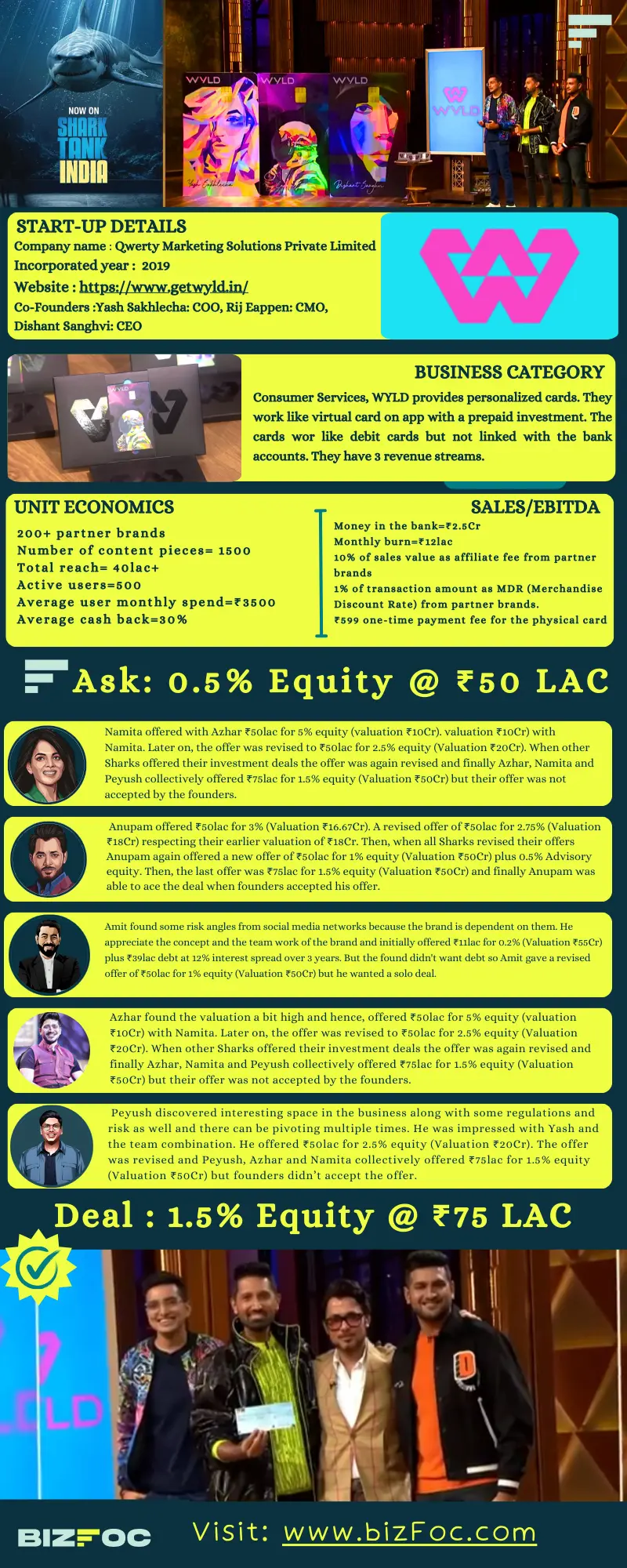
Money in the bank=₹2.5Cr Monthly burn=₹12lac Revenue Streams: 10% of sales value as affiliate fee from partner brands 1% of transaction amount as MDR (Merchandise Discount Rate) from partner brands. ₹599 one-time payment fee for the physical card Unit Economic: 200+ partner brands Number of content pieces= 1500 Total reach= 40lac+ Active users=500 Average user monthly spend=₹3500 Average cash back=30% |
| Ask | ₹50lacs for 0.5% equity (Valuation ₹100Cr) |
| Pre-round | Jan’22= ₹2.75Cr (Valuation ₹18Cr), Aug’22= ₹2.5Cr (₹55Cr floor valuation) |
| Deal pakki? | The founders accepted Anupam’s deal of ₹75lac for 1.5% equity (Valuation ₹50Cr) |
WYLD, a brand registered with the company name as Qwerty Marketing Solutions Private Limited with the incorporation date on March 29, 2019. This company is registered in Mumbai, Maharashtra, India. They currently have more than 200 partner brands with a total reach of more than 40lac.
WYLD is owned by Yash Sakhlecha, Rij Eappen, and Dishant Sanghvi. Yash serves as the COO, Rij as CMO, and Dishant as CEO. The business was started in July 2023. All the three founders are from Mumbai.
WYLD is the world's first social currency powered payments card VISA payments bank. It provides earning opportunities to Instagram users with 1k+ followers. Users can apply for a WYLD Card on the website, get approved, and then shop or dine at partner brands or restaurants. After making a purchase, users need to post a picture or upload a story on Instagram, tag the partner brand and WYLD, and receive cashback ranging from 30% to 100% on the card. Cashback can be used for any purchase or payment. WYLD provides personalized cards that function like virtual cards on the app with prepaid investment. These cards work like debit cards but are not linked with bank accounts. The business has three revenue streams: charging 10% of sales value as an affiliate fee from partner brands, 1% of the transaction amount as Merchandise Discount Rate (MDR) from partner brands, and ₹599 as a one-time fee for physical cards. The vision is to provide social media users and influencers with a better and upgraded lifestyle with benefits.
WYLD provides earning opportunities for influencers with more than 1k+ followers. Users can apply for a WYLD card on their website: https://www.getwyld.in/.
WYLD presented their pitch in Shark Tank India seeking an investment of ₹50lacs for 0.5% equity (Valuation ₹100Cr).
The Sharks' decisions reflect several key considerations for WYLD:
Strengths:
Weaknesses:
While companies are increasingly looking to social media platforms for advertisements and digital marketing, WYLD Card shows potential for future growth. Additionally, companies can save up to 80% of their marketing costs using WYLD Card, making it an attractive proposition for prospective client companies.
WYLD Card's appearance on Shark Tank India Season 3 showcased how a business can leverage social media platforms to provide a steady source of income to influencers with even a modest following. The business model's ability to provide an 80% reduction in marketing costs for client companies is a strong selling point. Overall, WYLD Card has positive growth prospects for the future.

More trusted, Verified reviews
 180+ Reviews
Bizfoc is an accounting firm offering solutions related to company registration in India, accounting services, stock audit, GST, TDS & income tax. Our team exemplifies brilliance in distinct industries using flexible and customized solutions.


Unit No. 235, II Floor, JMD Megapolis Sohna Rd,Sector 48 Gurugram, Haryana, 122018
Unit No. 2303A, 23rd Floor, The Iconic Corenthum, Sector 62, Noida, Uttar Pradesh, 201309 (Next to Noida Electronic City Metro Station)
© 2024 Bizfoc. All Rights Reserved. Made with