
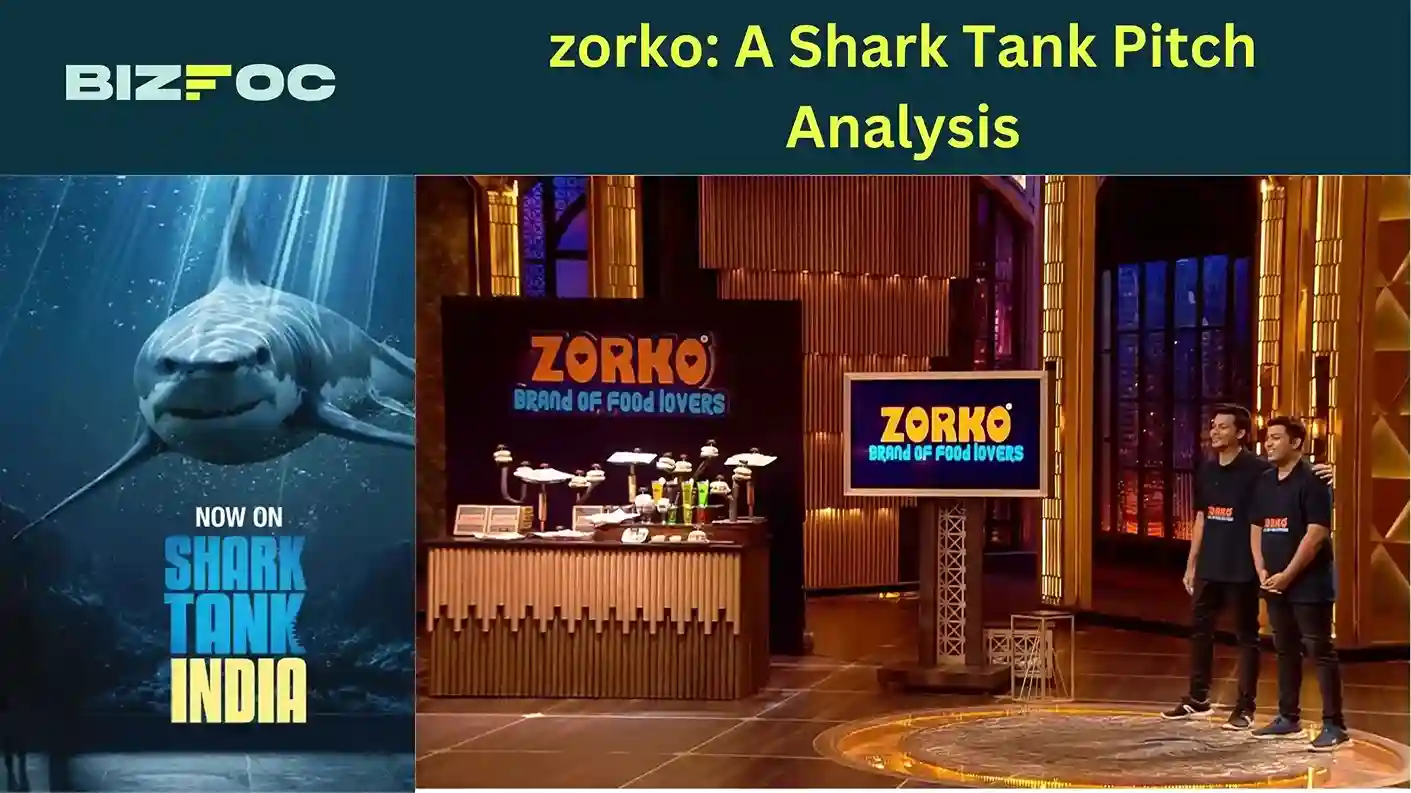
Zorko, a brand founded by Amrit Nahar & Anand Nahar, was recently featured on Shark Tank India Season 3, aiming to secure investment for their organized fast food chains. This analysis delves into the details of Zorko, encompassing its establishment, ownership structure, business model, products, and the Sharks' decisions regarding their pitch.
| Airing time | January 30, 2024 Episode 7 (Season 3) |
| Brand | Zorko |
| Company Name | ZORKO Private Limited |
| Company Registration | Vesu, Surat, Gujarat, India |
| Company Incorporation Date | June 18, 2020 |
| Business Category | Food & Beverage Manufacturing |
| USP | More than 80 fast food items under one roof with a unique taste, soothing ambiance, and affordable price |
| Co-founders/Directors | Co-founders: Amrit Nahar & Anand Nahar |
| Company Authorized Capital | ₹1,00,000 |
| Company Paid-up Capital | ₹1,00,000 |
| Website | https://zorko.in/ |
| Sales/EBITDA/Profits |
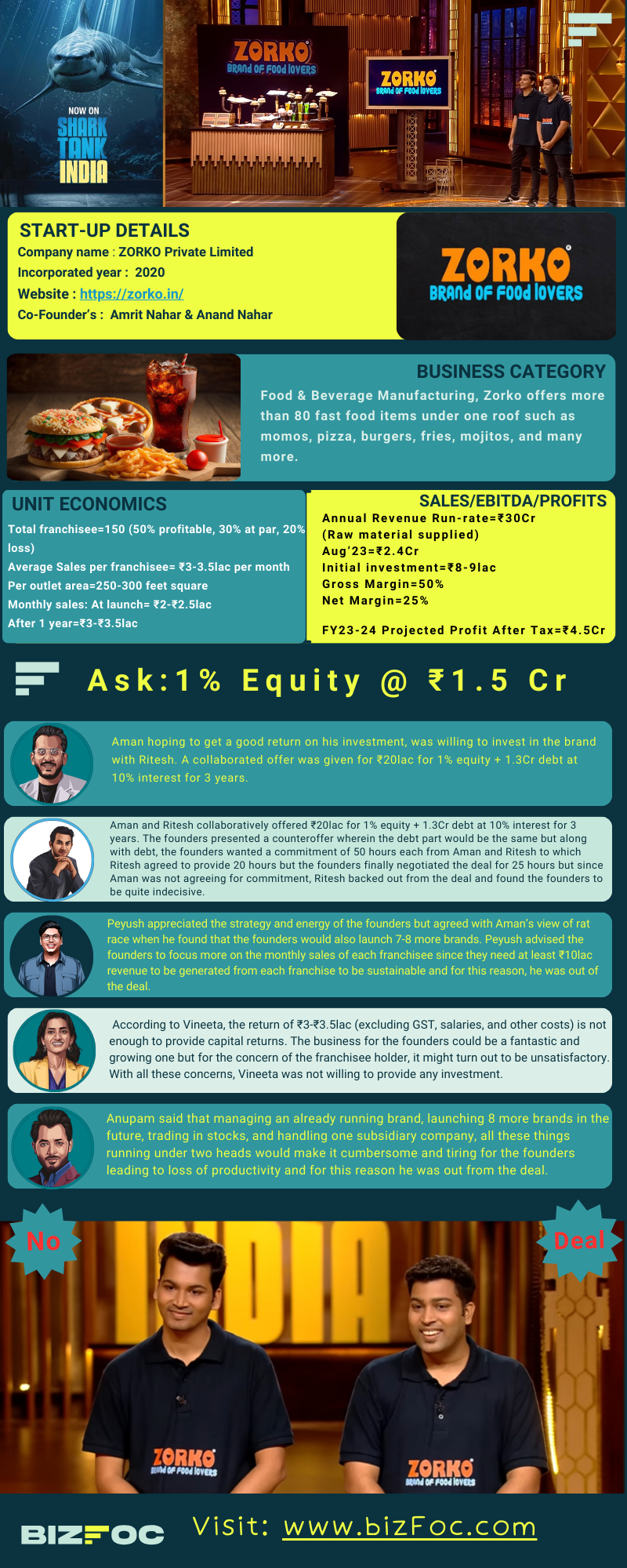
Annual Revenue Run-rate: ₹30Cr (Raw material supplied) Aug’23: ₹2.4Cr Initial investment: ₹8-9lac Gross Margin: 50% Net Margin: 25% Return on Investment: 12 months Franchise fee: ₹3.99lac Zorko’s Brand’s Gross Margin: 40% Zorko’s Brand’s Profit Margin Before Tax: 20% FY23-24 Projected Profit After Tax: ₹4.5Cr Cost of factory acquired under Zorko Ventures Private Limited (Subsidiary company to enter food business)=₹2Cr Total franchisee: 150 (50% profitable, 30% at par, 20% loss) Average Sales per franchisee: ₹3-3.5lac per month Per outlet area: 250-300 feet square Monthly sales: At launch: ₹2-₹2.5lac After 1 year: ₹3-₹3.5lac |
| Ask | ₹1.5Cr for 1% equity (Valuation ₹150Cr) |
| Pre-round | NA |
| Deal pakki? | The deal could not be done because of the indecisiveness of the founders. |
Zorko has the company name ZORKO Private Limited with company incorporation date on January 18, 2020. This company is registered in Vesu, Surat, Gujarat, India. With around 150 established fast food chains in more than 42 cities and villages covering more than 6 states, Zorko has set up 150 outlets in just 17 months. Zorko provides quality fast food at an affordable piece and operates on a chef-less model.
Amrit Nahar and Anand Nahar are the co-founders of Zorko. Amrit and Anand share the blood relationship of brothers. The company has authorized capital which amounts to ₹1.00lac, with a paid-up capital of ₹1.00lac. Anand Nahar has done B.Tech and is also a SEBI Registered Research Analyst. Amrit Nahar studied Environmental Engineering and did a Masters in Anthropology. While working as a Research Analyst with SEBI, he used to evaluate SMEs and then got a spark to build his own SME of a food brand which requires less investment and generates high returns. From there Zorko started.
Zorko is a pure veg fast food franchise chain. It has more than 80 items under one roof ranging from burgers, pizza, and momos to mojitos and many more. Zorko offers food items at affordable prices while maintaining all the quality and safety checks. Zorko has developed a soothing ambiance at the outlets to provide ease and comfort to the customers. Zorko works on a chef-less model. The SOPs (Standard Operating Procedure) are made in a manner that anybody can learn within 48 hours. For acquiring franchisees, Zorko approaches those customers who come visit the outlets at least 4 times and that person or his friend is offered to become the brand ambassador of Zorko. Zorko is available across 42 cities and villages covering 6 states of India within a span of 17 months. The vision is to open 1000 outlets in the upcoming 1000 days and also enter into the market segment of hotels, catering, and restaurants.
Zorko offers more than 80 fast food items under one roof such as momos, pizza, burgers, fries, mojitos, and many more. Detailed information about their fast food items can be found at: https://zorko.in/zorko-franchise/
Zorko presented their pitch in Shark Tank India seeking an investment of ₹1.5Cr for a 1% equity stake (Valuation ₹150Cr).
The analysis of Shark Decisions highlights several key considerations for Zorko:
Strengths:
Weaknesses:
Zorko portrays a promising future but needs to address certain concerns, such as the pace of expansion and strategic focus. While the founders' energy and enthusiasm are commendable, they must ensure sustainable growth and operational excellence. Streamlining operations, focusing on core offerings, and strengthening leadership capabilities will be crucial for long-term success.
The appearance of Zorko in Shark Tank India Season 3 shows how the founders were trying to enter into every segment be it launching new brands, opening a subsidiary company, or opening 150 outlets within 17 months. Their vision to open 1000 outlets in the upcoming 1000 days and also enter into the market segment of hotels, catering, and restaurants seems feasible with proper direction and guidance. The pitch also shows that indecisiveness at the right time can lead to major loss just like the founders lost their deal because of indecisiveness and adamant attitude.

More trusted, Verified reviews
 180+ Reviews
Bizfoc is a leading accounting firm specialising in a wide spectrum of services covering company registration in India, accounting, stock audits, GST, ESOP, FEMA, import export and income tax returns filing. Our outstanding teams excel across various industries, offering customised solutions that compare to none in quality.


75–76, Adchini Hauz Khas (South Delhi) New Delhi – 110017, India
Unit No. 235, II Floor, JMD Megapolis Sohna Rd, Sector 48 Gurugram, Haryana, 122018
Unit No. 2303A, 23rd Floor, The Iconic Corenthum, Sector 62, Noida, Uttar Pradesh, 201309
Unit No. 402, Myhome Vihanga, Gachibowli, Hyderabad, Telangana, 500032
C-701, Elegant Residency Phase II, Nigdi, Near Inspiria Mall, Pune, 411044
6/207, Vipul Khand, Gomti Nagar, Lucknow, 226010
© 2026 Bizfoc Business Solutions Private Limited. All Rights Reserved. Made with