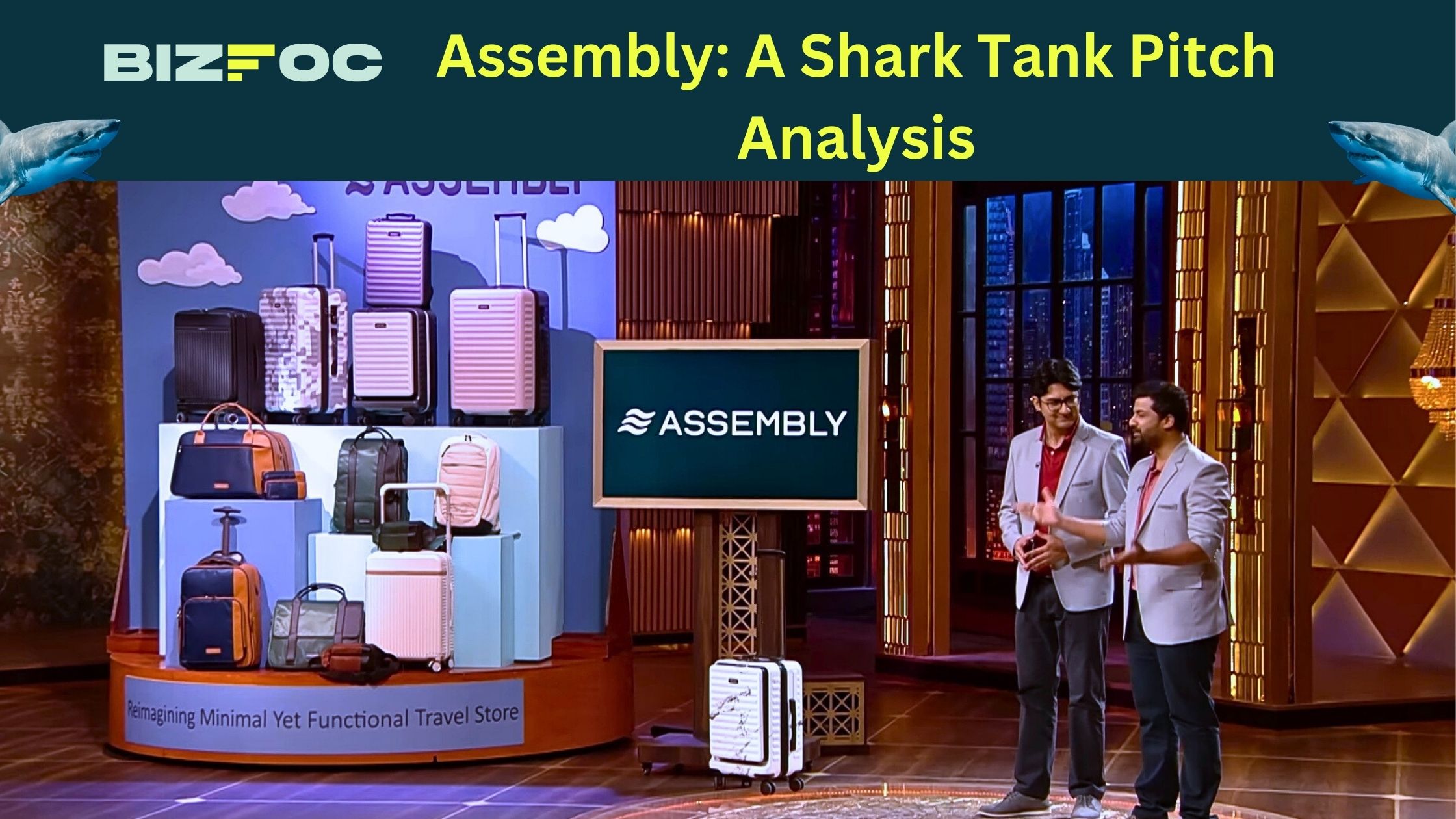
India is growing and travel is becoming a part of everyone's life. Assembly is a new-age luggage brand that offers functional, budget-friendly, and good-looking bags and travel accessories. They offer functional features such as a laptop section, separate space for keeping shoes, a hard shell for protection, and a charging cable space. Along with functionality, they have an equal focus on design and the quality of the products.
| Airing time | 9 February, 2024 Episode 15 (Season 3) |
| Brand | Assembly |
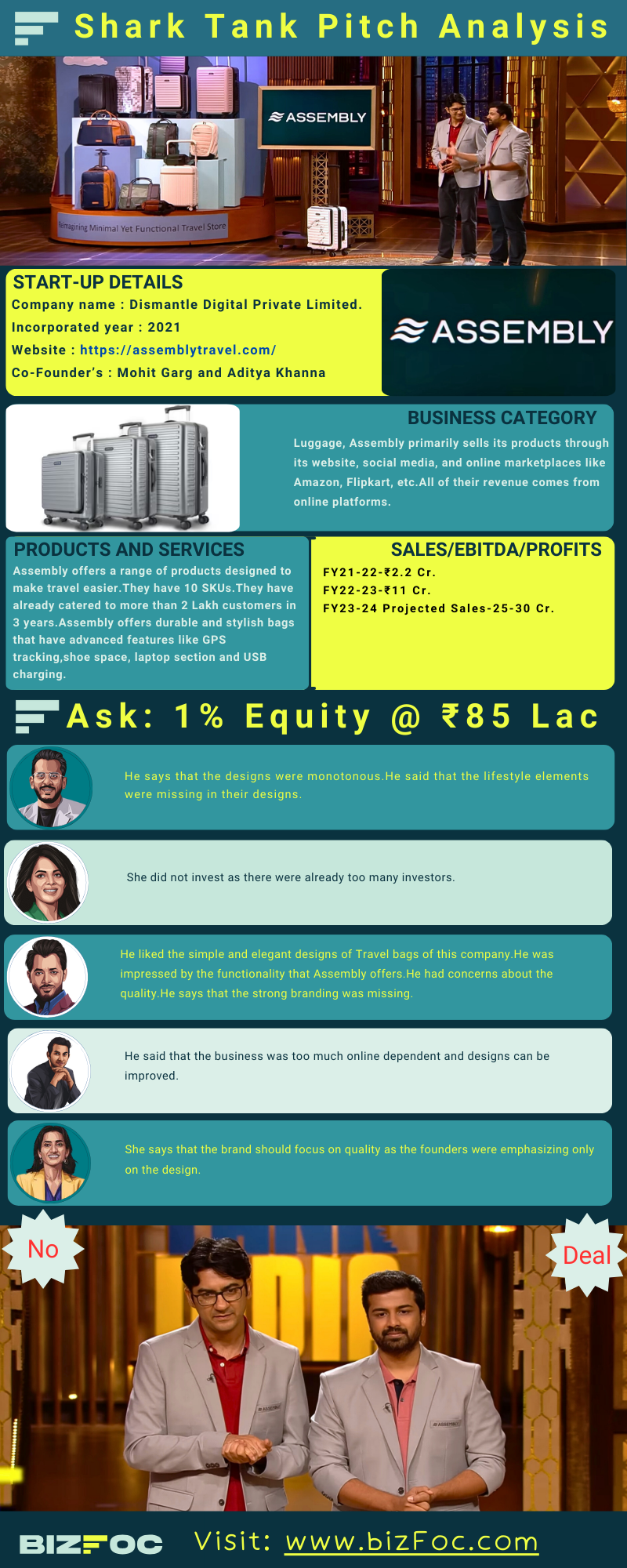
| Company Name | Dismantle Digital Private Limited |
| Company Registration | D-92, South City 1, Gurugram, Haryana, India |
| Company Incorporation Date | 17 July 2021 |
| Business Category | Luggage |
| USP | Design |
| Co-founders/Directors | Mohit Garg and Aditya Khanna |
| Company Authorized Capital | ₹3 Lakh |
| Company Paid-up Capital | ₹157,180 |
| Website | https://assemblytravel.com/ |
| Sales/EBITDA/Profits |
FY21-22: ₹2.2 Cr. FY22-23: ₹11 Cr. FY23-24 Projected Sales: ₹25-30 Cr. |
| Unit Economic |
Selling price: ₹100 GST: ₹15 COGS: ₹42 Marketing cost: ₹20 Shipping cost: ₹8 Contribution Margin: ₹15 |
| Business Valuation Ask | ₹85 Lakh for 1% equity |
| Pre-round | 2022: ₹2.3 Cr. at a valuation of ₹15 Cr. |
| Deal Pakki? | No |
Assembly was founded by Mohit Garg and Aditya Khanna. The equity split of the company is as follows:
90% of the production is outsourced to Mohit’s family business. Assembly primarily sells its products through its website, social media, and online marketplaces like Amazon and Flipkart. All of their revenue comes from online platforms. They get 45% of sales from prominent marketplaces such as Amazon and Flipkart, 50% through their own website, and the rest from corporate B2B. By selling directly to customers online, Assembly eliminates intermediaries, reduces costs, and enables competitive pricing. Their target market is people aged 25-40 years. They are expecting a revenue of ₹25-30 Cr in the financial year 2023-24.
Assembly offers a range of products designed to make travel easier. They have 10 SKUs and have already catered to more than 2 lakh customers in 3 years. Assembly offers durable and stylish bags that have advanced features like GPS tracking, shoe space, laptop section, and USB charging. Assembly aims to disrupt the traditional luggage industry, offering innovative, affordable, and stylish products to Indian consumers.
BizFoc has provided an analysis of the Shark decisions related to Assembly's pitch, assessing the strengths and weaknesses, and the potential impact on the future of Assembly.
Assembly's strengths include its innovative product design and strong online presence. However, challenges include maintaining quality control with outsourced production and navigating competitive pricing strategies.
The future of Assembly looks promising as they continue to innovate and expand their product range, targeting a growing market of young travelers in India.
Assembly is well-positioned to capitalize on the growing demand for functional and stylish travel accessories in India. With a strong business model and a focus on innovation, they are poised for continued growth in the years ahead.
Assembly presented its Startup idea in Shark Tank India Season 3 Episode 15 seeking an investment of ₹85 Lakhs for 1% equity.
None of the sharks decided to invest in the business. Although the sharks were impressed with the concept and revenue, they had doubts about the design and differentiation from competitors. Quality was a significant concern, as the founders focused mainly on design. Additionally, the company had many existing investors, and the branding of the product was not done effectively, with the brand's logo not even present on the products. The company was also not profitable, leading the sharks to be reluctant to invest.
Strengths:
Weaknesses:
The future of this brand seems promising as they are growing at an exponential rate. Their vision is to become India's biggest thoughtful travel store in the next 3 to 5 years. Their future target is to achieve ₹80 Cr annual revenue in the next 18-24 months. Appearing on Shark Tank has put this brand into the spotlight, potentially leading to brand recognition and more sales. If the company strategically spends on marketing and offline channels, it is going to be one of the biggest luggage brands.
The founders of Assembly, a luggage brand, pitched their business seeking ₹85 Lakh for 1% equity. They showcased their innovative products, including carry-on luggage with various functional features. However, the sharks did not invest due to concerns about design, quality, the number of existing investors, and the crowded market with already established brands.

More trusted, Verified reviews
 100+ Reviews

Bizfoc is a leading accounting firm specialising in a wide spectrum of services covering company registration in India, accounting, stock audits, GST, ESOP, FEMA, import export and income tax returns filing. Our outstanding teams excel across various industries, offering customised solutions that compare to none in quality.


75–76, Adchini Hauz Khas (South Delhi) New Delhi – 110017, India
Unit No. 235, II Floor, JMD Megapolis Sohna Rd, Sector 48 Gurugram, Haryana, 122018
Unit No. 2303A, 23rd Floor, The Iconic Corenthum, Sector 62, Noida, Uttar Pradesh, 201309
Unit No. 402, Myhome Vihanga, Gachibowli, Hyderabad, Telangana, 500032
C-701, Elegant Residency Phase II, Nigdi, Near Inspiria Mall, Pune, 411044
6/207, Vipul Khand, Gomti Nagar, Lucknow, 226010
© 2026 Bizfoc Business Solutions Private Limited. All Rights Reserved. Made with
 Why Trust Us
 Trust Us
 Our Founder
 Reviews