
By creating cutting-edge, reasonably priced, easily accessible, and very precise monitoring technologies for emerging markets, NemoCare seeks to eradicate all avoidable newborn and maternal deaths in the developing world. To provide continuous, high-resolution monitoring and preventive care for every patient in the hospital and at home—ensuring that no effort is spared to prevent any form of mortality or morbidity—we employ unobtrusive wireless wearable sensors and networks, analytical algorithms, and big data as tools. We develop life-saving devices that will revolutionize the delivery of healthcare using the concepts of design thinking. The novel wearable Nemocare Raksha monitors infants' vital signs continually to enhance neonatal care. The detection of ailments including apnea, hypothermia, and other danger signs is the device's primary focus. It tracks vital signs including body temperature, heart rate, respiration rate, and blood oxygen saturation using inconspicuous wireless sensors. The gathered information is sent to a central platform, which enables medical professionals to keep an eye on several newborns at once and get notifications for prompt actions. This system may be used at home or in hospitals because it is easy to use and doesn't require any professional training. Because of its price and mobility, it may be used for both Kangaroo Mother Care and transportation. This Startup made the pitch in Shark Tank Season 3 which was covered in the 43rd episode.
| Airing time | Shark Tank Season 3: Episode 43 |
| Brand | Nemocare Raksha |
| Company Name | NEMOCARE WELLNESS PRIVATE LIMITED |
| Company Registration | Hyderabad, India |
| Company Incorporation Date | 13th July 2017 |
| Business Category | Social HealthCare AI |
| USP | NeoNatel Wearable Vital Monitor |
| Co-founders/Directors | Pratyusha Pareddy and Manoj Sanker |
| Company Authorized Capital | ₹30 Lakhs |
| Company Paid-up Capital | ₹5 Lakhs |
| Website | www.nemocare.in |
| Sales/EBITDA/Profits |
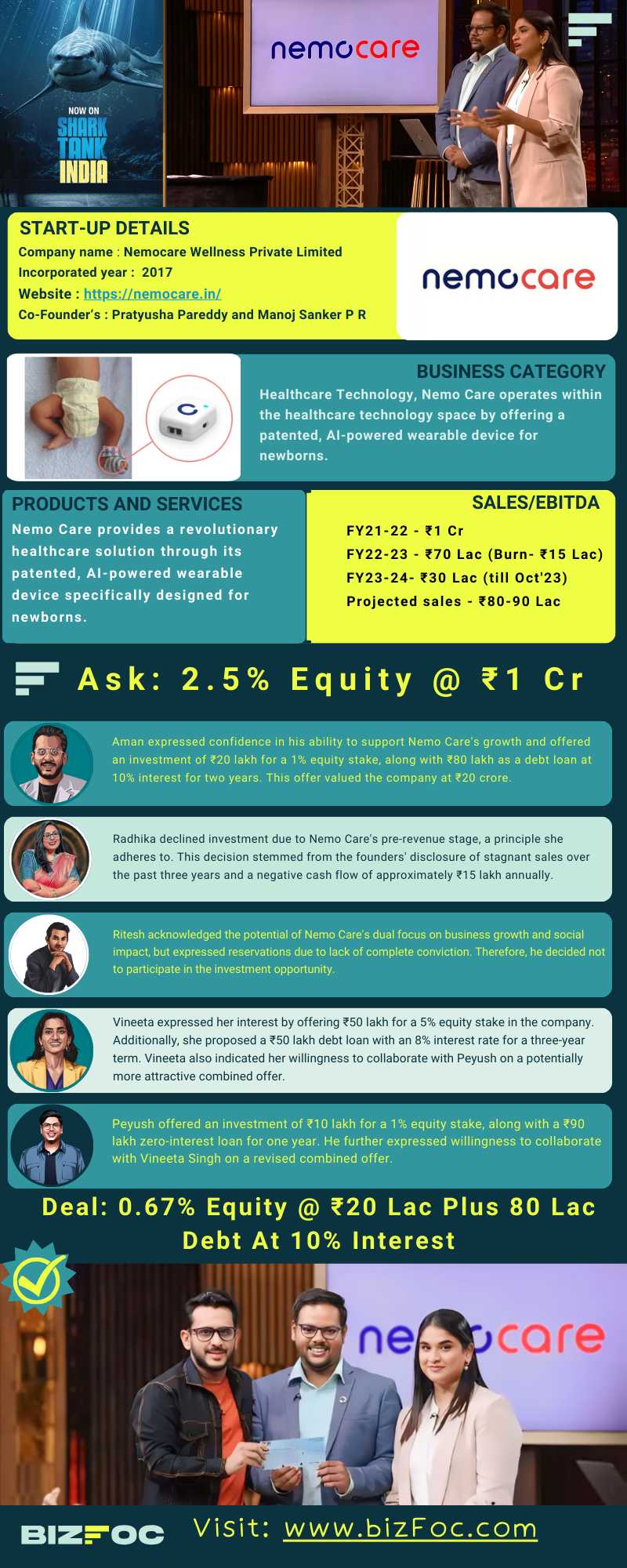
Sales Split: CSR: 90% Others: 10% Sales: FY21-22: ₹1 Cr FY22-23: ₹70 Lakhs FY23-24: ₹30 Lakhs (till October) FY23-24: ₹80 Lakhs (Projected) |
| Unit Economic | NA |
| Business Valuation Ask | ₹1 Cr for 2.5% equity at the business valuation of ₹40 Cr. |
| Pre-round | NA |
| Deal Pakki? | ₹20 Lakhs for 0.67% equity at the business valuation of ₹30 Cr with ₹80 Lakhs Debt at 10% Interest for 2 years with Shark Aman. |
NemoCare Raksha has the Company name with NEMOCARE WELLNESS PRIVATE LIMITED Company incorporation date on 13th July 2017. This company is registered in Hyderabad, India.
Pratyusha Pareddy and Manoj Sanker are the co-founders of NemoCare Raksha, where the founders hold 95% equity with themselves only and 5% with the Centre of HealthCare Entrepreneurship for Incubation Fund.
Using an inventive marketing strategy, Nemocare Raksha mainly targets medical professionals in Tier I, II, and III Indian cities, such as doctors, surgeons, and private nursing facilities. By using a profit-sharing business-to-business (B2B) model, the firm enables healthcare institutions to implement its technology with little out-of-pocket expenditure and split the money earned by its use. Government-run Special Newborn Care Units (SNCUs) in district hospitals, where access to cutting-edge medical equipment is sometimes restricted by budgetary restrictions, stand to benefit greatly from this concept. Furthermore, Nemocare Raksha distributes its gadgets to government settings by utilizing Corporate Social Responsibility (CSR) activities, guaranteeing that even the most marginalized individuals may benefit from their life-saving equipment. Nemocare Raksha seeks to lower newborn death rates and enhance the quality of life for new mothers by emphasizing affordability and accessibility.
A wearable for newborns, the flagship device "Nemocare Raksha" continually monitors the vital signs required to identify hypothermia, apnea, and other distress symptoms. An integrated diagnostic instrument that wirelessly links to a central platform so the nurse can keep an eye on every baby at once and sound the alarm if something is amiss. Key vital parameters are continually monitored, distress circumstances are identified and the caregiver is notified to intervene promptly. The data is safely stored so that the physician may access it at a later time. This gadget is especially good at identifying illnesses like hypothermia and apnea and notifying caretakers in real-time so they can take appropriate action. The gadget gathers data, which is electronically sent to a central platform so that medical professionals may keep an eye on several newborns at once. This system may be used at home or in hospitals because it is easy to use and doesn't require any professional training. Nemocare Raksha also provides a clinical decision support system driven by artificial intelligence (AI) that aids in evaluating the gathered data to forecast any health problems and recommend preventative actions. Their products are incredibly adaptable and accessible since they are economical, portable, and suitable for both transit and Kangaroo Mother Care. Detailed information about their services can be found at: www.nemocare.in.
NemoCare Raksha presented their pitch in Shark Tank India seeking an investment of ₹1 Cr for 2.5% equity at the business valuation of ₹40 Cr.
As the founder was getting their aim aligned with Shark Aman and hence after certain negotiations, they cracked a deal with him of ₹20 Lakhs for 0.67% equity at the business valuation of ₹30 Cr with ₹80 Lakhs Debt at 10% Interest for 2 years.
The device's ability to continually monitor a newborn's vital signs and provide real-time alarms for issues like apnea and hypothermia thrilled the Sharks, potentially saving lives. One of the Sharks, Radhika Gupta, related strongly to the proposal since she had firsthand experience with newborn care. She discussed how spending her early years in an incubator caused her to have health problems that have persisted throughout her life, highlighting the significance of easily available and efficient neonatal care solutions. The device's potential influence on several families was brought to light by this emotional link, especially in impoverished communities where access to sophisticated medical facilities is limited. The Sharks valued the device's integration of IoT and AI technology to offer a complete monitoring solution that is user-friendly and reasonably priced. They were particularly pleased by the ₹6 crores in grants that Nemocare had previously obtained, which showed the legitimacy and promise of the business. The Sharks gave a favorable response at the end of the pitch, recognizing Nemocare Raksha's huge social effect and business potential.
Strengths:
Weaknesses:
Through partnerships with groups like UNICEF and QUALCOMM, Nemocare Raksha hopes to increase its presence in Latin America, Africa, and Southeast Asia in addition to India. The business intends to use a profit-sharing B2B model to sell its product in India, making it available to healthcare providers. Nemocare Raksha is dedicated to ongoing innovation and is creating life-saving technology for newborn care by applying design thinking concepts.
NemoCare Raksha's pitch highlighted key strengths in their business model and product. Further, the Sharks felt that investing in this would be pretty profitable and hence, founders got a great deal.

More trusted, Verified reviews
 100+ Reviews

Bizfoc is a leading accounting firm specialising in a wide spectrum of services covering company registration in India, accounting, stock audits, GST, ESOP, FEMA, import export and income tax returns filing. Our outstanding teams excel across various industries, offering customised solutions that compare to none in quality.


75–76, Adchini Hauz Khas (South Delhi) New Delhi – 110017, India
Unit No. 235, II Floor, JMD Megapolis Sohna Rd, Sector 48 Gurugram, Haryana, 122018
Unit No. 2303A, 23rd Floor, The Iconic Corenthum, Sector 62, Noida, Uttar Pradesh, 201309
Unit No. 402, Myhome Vihanga, Gachibowli, Hyderabad, Telangana, 500032
C-701, Elegant Residency Phase II, Nigdi, Near Inspiria Mall, Pune, 411044
6/207, Vipul Khand, Gomti Nagar, Lucknow, 226010
© 2026 Bizfoc Business Solutions Private Limited. All Rights Reserved. Made with
 Why Trust Us
 Trust Us
 Our Founder
 Reviews