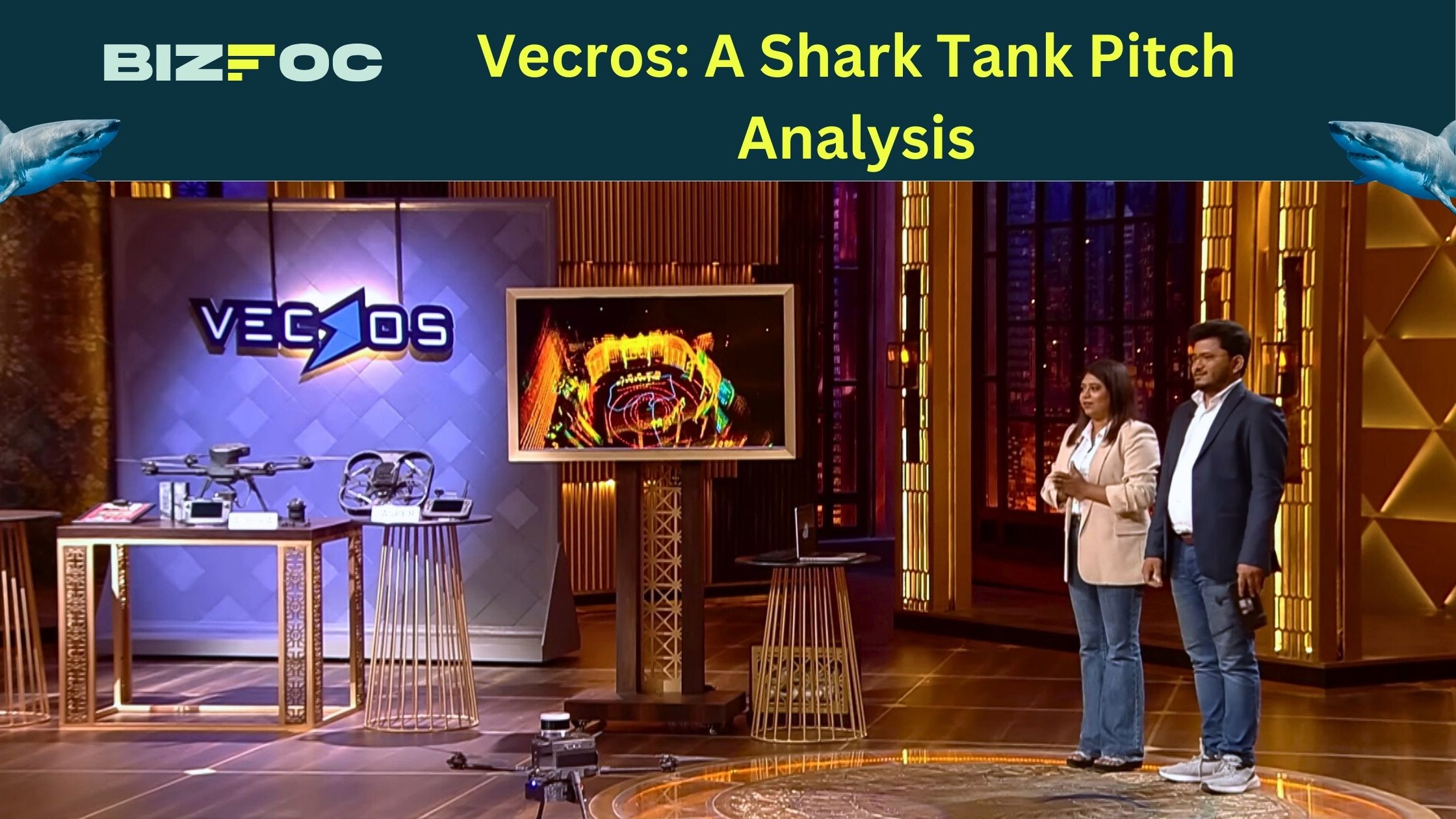
Vecros is a Delhi-based robotics company that appeared on Shark Tank India Season 3 Episode-10. It introduced India's first AI spatial drone, Athera. Athera is designed for industries such as construction, oil and gas, railway disaster relief, and utilities. Athera has advanced features like GPS-denied navigation and 360-degree obstacle avoidance.
| Airing Time | Shark Tank India Episode 10 (Season 3) |
| Brand | Vecros |
| Company Name | Vecros Technologies Pvt. Ltd. |
| Company Registration | Navodaya Colony, Anantapur, Andhra Pradesh 515001 |
| Company Incorporation Date | 12 October 2018 |
| Business Category | Drones |
| USP | Spatial AI Drone |
| Co-founders/Directors | Besta Prem Sai and Bestha Gangadevi |
| Company Authorized Capital | ₹87.5 Lakh |
| Company Paid-up Capital | ₹40,92,480 |
| Website | https://vecros.com/ |
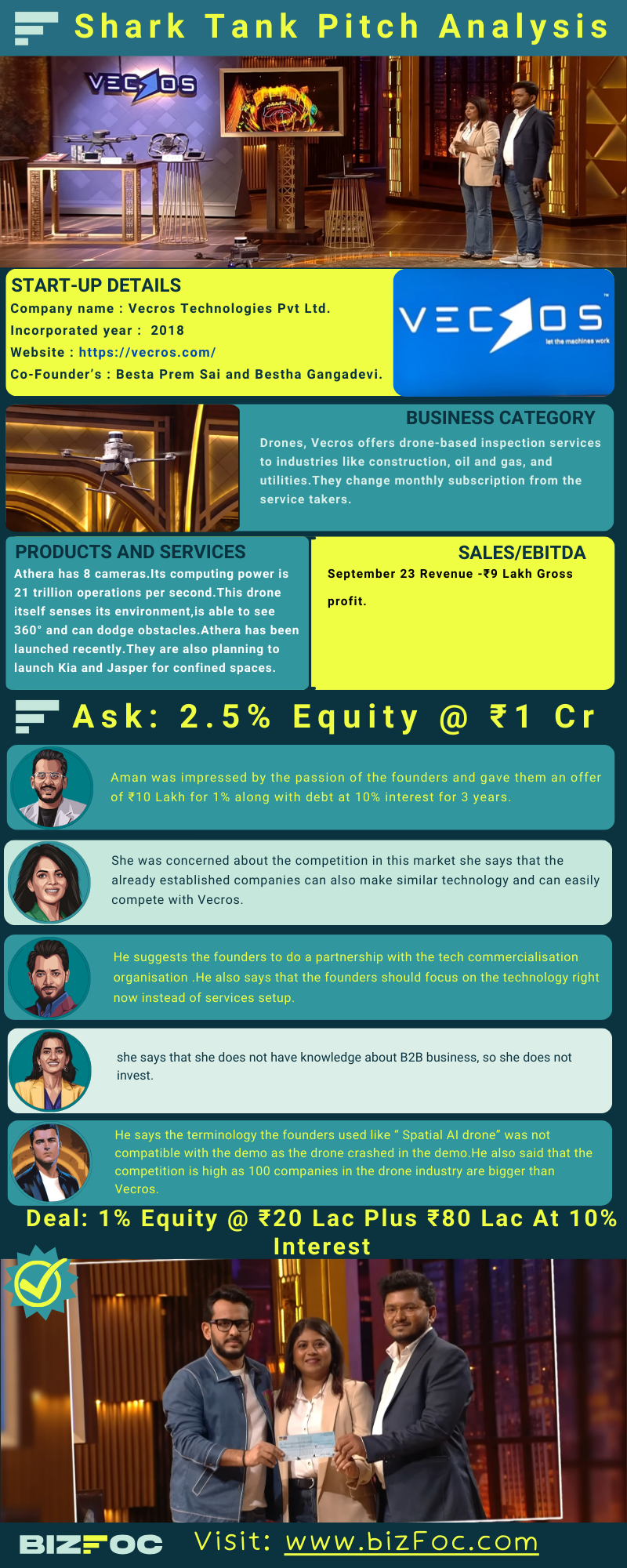
| Sales/EBITDA/Profits | September 23 Revenue - ₹9 Lakh Gross Profit |
| Unit Economic | Price of a Drone - ₹25 Lakh Gross Margin - ₹9 Lakh |
| Business Valuation Ask | ₹1 Cr for 2.5% equity |
| Pre-round | ₹2 Cr at a valuation of ₹22 Cr |
| Deal Pakki? | Yes. ₹20 Lakh for 1% and debt ₹80 Lakh at 10% interest for 3 years. |
Vecros Technologies Private Limited is a private limited company founded on October 12, 2018. The founders are Besta Prem Sai and Bestha Gangadevi. The headquarters are located in Anantapur, Andhra Pradesh, India, with an additional office in New Delhi. The company operates in the information technology, electronic equipment, and instruments industry. Vecros Technologies has a team of 7 employees and has secured $250K in funding from 13 investors, with its latest funding round being a seed round. The authorized capital is ₹87.5 Lakh and paid-up capital is ₹40,92,480.
Besta Prem Sai and Bestha Gangadevifounded Vecros. Aman Gupta invested ₹20 lakhs for 1% equity and ₹80 lakhs in debt at a ₹20 crores valuation.The company had received a 70% acquisition offer for ₹15 crores but declined it.
Drone as a Service: Vecros offers drone-based inspection services to industries like construction, oil and
gas, and utilities. They charge a monthly subscription from the service takers.
Enterprise model: Vecros also offers drones, softwares to the customers who can do inspection by
themselves and the founder trains them on how to use the technology.
Athera has 8 cameras. Its computing power is 21 trillion operations per second. This drone itself senses its environment, is able to see 360° and can dodge obstacles. Athera has been launched recently. They are also planning to launch Kia and Jasper for confined spaces.
Vecros presented their pitch in Shark tank India Episode 9 seeking an investment of ₹1 Cr for 2.5% equity at a valuation of ₹25 Cr.
The deal was settled with Aman at ₹10 Lakh for 1% equity and ₹80 Lakh debt at 10% interest for 3 years.
Vecros is a tech startup that develops autonomous drones, particularly the ATHERA, which can be used in construction, inspection, and disaster relief. The founders asked for ₹1 crore for 2.5% equity, but Aman Gupta invested ₹20 lakhs for 1% equity and ₹80 lakhs in debt at 10% for 3 years. The pitch started with a drone demo that ended in an accident, which caused insecurity among the sharks regarding the technology. The sharks were also concerned about the competition in this industry. The company has two revenue streams: selling drones and providing drone services.
Strengths:
Weaknesses:
The future of Vecros startup lies in the hands of the founders on how they are able to crack the advanced technology and sustain themselves in the market as the competition is intense with the already established brands and newcomers. The product Athera is of diverse use but it is costly. Hence the scalability of the product is crucial. Collaborations with various industries like construction, oil and gas, and disaster relief agencies could lead to more adoption and increased revenue. It is also expected that the drone market will grow in India. Thus Vecros needs to focus on product advancement to cater to diverse industries and applications.
Vecros, a drone tech startup, pitched their autonomous drones and drone-agnostic operating system to the sharks, seeking ₹1 Cr for 2.5% equity. Despite initial concerns, Aman Gupta invested ₹20 lakhs for 1% equity and ₹80 lakhs for 3 years at 10% interest in debt, seeing potential in their innovative technology. The sharks were doubtful about the technology due to the accident that occurred during the demo. Other sharks did not invest, showing concerns about marketability and the competition.

More trusted, Verified reviews
 100+ Reviews

Bizfoc is a leading accounting firm specialising in a wide spectrum of services covering company registration in India, accounting, stock audits, GST, ESOP, FEMA, import export and income tax returns filing. Our outstanding teams excel across various industries, offering customised solutions that compare to none in quality.


75–76, Adchini Hauz Khas (South Delhi) New Delhi – 110017, India
Unit No. 235, II Floor, JMD Megapolis Sohna Rd, Sector 48 Gurugram, Haryana, 122018
Unit No. 2303A, 23rd Floor, The Iconic Corenthum, Sector 62, Noida, Uttar Pradesh, 201309
Unit No. 402, Myhome Vihanga, Gachibowli, Hyderabad, Telangana, 500032
C-701, Elegant Residency Phase II, Nigdi, Near Inspiria Mall, Pune, 411044
6/207, Vipul Khand, Gomti Nagar, Lucknow, 226010
© 2026 Bizfoc Business Solutions Private Limited. All Rights Reserved. Made with
 Why Trust Us
 Trust Us
 Our Founder
 Reviews