Publishing Date: 18 Feb, 2025

Choosing a right business structure is a crucial step as it has a large impact on your whole business setup. There are a variety of business forms such as Private Limited Company, Limited Liability Partnership, Partnership, Sole Proprietorship & One Person Company. One can go for any business form for their business but it is advised to understand their various features in detail. In this blog, you’ll get a complete comparison between different Business Forms.
Different Business forms have unique features, advantages & disadvantages as well. Following is the detailed comparison between different business forms on the basis of:
Note: Also, there are some other differences than these major points, one can refer to the following image for better understanding.
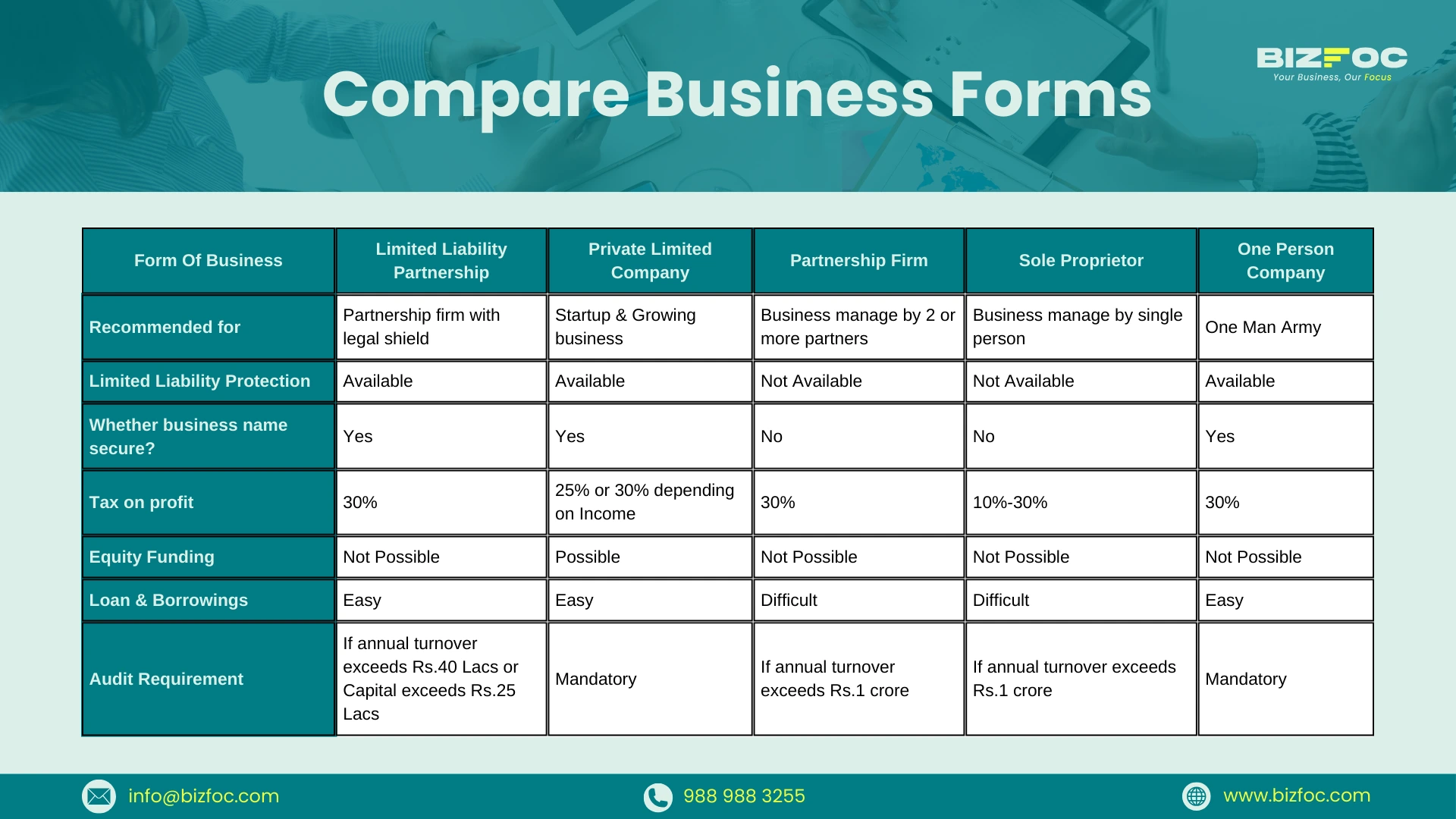
Different Business forms have different features and identities. It is recommended to understand the major difference between them before starting your business. Each Business is recommended for different purposes such as a Private Limited Company is suggested for Startups & Growing Business while an LLP should be formed as a Partnership firm with legal shield. A Sole Proprietor firm & OPC is managed by a single person while there can be multiple partners in LLP & Partnership firms. The decision of selecting the right business form totally depends on your Business aim & plan.
1) Is Audit mandatory for Private Limited Company & LLP?
Yes, for Private Limited Company Audit is mandatory while for LLP it is only required if the turnover exceeds ₹40 lakh and the capital contribution ₹25 lakh.
2) Can LLP have more partners than Partnership?
Yes, an LLP can have unlimited partners while there can be a maximum of 100 partners in a Partnership.
3) What happens to business if the partner leaves in a Partnership?
If a partner leaves a partnership, the organization can be continued with another partner or it may dissolve depending on the Partnership Agreement.
4) Which structure is better for raising investment: LLP or OPC?
OPC are considered more suitable for raising investment as they follow private limited company structure and can be converted in near future while LLP can’t attract investors for equity shares to raise investment like OPCs.
5) Can a Sole proprietorship continue if the owner dies?
No, if the owner of sole proprietorship dies, it will come to an end while the company can continue if the owner dies.

CA Nayani Agarwal


Difference Among Society, Trust and Section 8 Company
28 Jun, 2025
Difference between Notary and Apostille
28 Jun, 2025
Top 14 Tools & Website to Grow a Brand
19 May, 2025
How to find Virtual Office for Company Registration in India?
03 May, 2025
Is Virtual Office Legal in India?
03 May, 2025
Share article via:







Bizfoc is a leading accounting firm specialising in a wide spectrum of services covering company registration in India, accounting, stock audits, GST, ESOP, FEMA, import export and income tax returns filing. Our outstanding teams excel across various industries, offering customised solutions that compare to none in quality.


75–76, Adchini Hauz Khas (South Delhi) New Delhi – 110017, India
Unit No. 235, II Floor, JMD Megapolis Sohna Rd, Sector 48 Gurugram, Haryana, 122018
Unit No. 2303A, 23rd Floor, The Iconic Corenthum, Sector 62, Noida, Uttar Pradesh, 201309
Unit No. 402, Myhome Vihanga, Gachibowli, Hyderabad, Telangana, 500032
C-701, Elegant Residency Phase II, Nigdi, Near Inspiria Mall, Pune, 411044
6/207, Vipul Khand, Gomti Nagar, Lucknow, 226010
© 2026 Bizfoc Business Solutions Private Limited. All Rights Reserved. Made with
 Why Trust Us
 Trust Us
 Our Founder
 Reviews